
I'm pleased to welcome Darcy Graves to Cozy Up With Kathy today. Darcy writes the Inspector Garrett Mystery series. THE HARLOT OF ST. CECILIA'S is the first book in the series and was released earlier this year. I hope you'll return to the blog Friday when I'll share my review.

Kathy: It is said that THE HARLOT OF ST. CECILIA'S is steeped in the style of the Golden Age of detective fiction. Who are some of your favorite authors of this time period and how did they influence this book?
DG: Ngaio Marsh is probably my favorite, but I also love Dorothy L. Sayers, Josephine Tey, Christianna Brand, and, of course, Dame Agatha.
I love the puzzles, so obviously that’s foundational. But sometimes even the older mysteries can feel flat if they are all about the puzzle.
What I really react to, and I think a lot of readers do, is the people and the world around the puzzle. For one thing, it’s simpler. A dear friend of mine recently said: “Sometimes I don’t want to deal with all the forensics and sexual assault and just want someone to get strangled by a string of pearls.” That resonates with me.
What I love and want to recreate is all the cleverness and wit in the Golden Age mysteries, which in some ways is just a characteristic of the time. Think of Dorothy Parker and Dash Hammett and all that snappy, smart wit. I love that.
I also really appreciate the writers who deliver meaningful character. Sayers, in particular, created characters who had rich lives outside the mechanics of the murder. Lord Peter Wimsey changes in those books. His relationships matter.
That was something I wanted for The Harlot of St. Cecelia’s. I wanted a mystery that could be solved, with clues that mattered, and sparkling repartee — but I also wanted Eden, Garrett, Simon, and the other characters to feel as though they had lives that existed before a body appeared and that those lives would continue meaningfully after the murderer was caught.
Kathy: In this, the first Inspector Garrett Mystery, Eden is accidentally locked overnight in the St. Cecelia’s Library vault. While I may not like being locked in a library vault, I would certainly enjoy being locked in a library. What about you?
DG: Hah! If it were a library like St. Cecelia’s, maybe… with its comfortable reading room, deep chairs, and far too many books, I think I could manage.
But I’ll be honest: there is something about libraries after dark that is slightly unnerving. Is there a more likely place to find ghosts than hiding in books? You have all those voices of people who have been dead for hundreds of years sitting quietly on the shelves, waiting for somebody to fall asleep in a reading room.
Kathy: While Detective Inspector William Garrett thinks he has an open-and-shut case, Eden follows the truth from the bright footlights of the London stage through the sleek drawing rooms of Jazz Age society. If you were in London in 1923, what would you most like to see and do?
DG: I would go straight to Gordon Square and people-watch.
I studied the Bloomsbury Group a lot when I was younger. I still have shelves full of their letters, diaries, monographs, biographies and whatnot. (I have a draft of a play about Vanessa Bell in my unfinished projects folder.) So I would absolutely sit on a bench in Gordon Square, hoping John Maynard Keynes or Lytton Strachey wandered past in the thick of an argument.
After that, I’d want to see London at night.
I’d find one of the nightclubs beginning to spring up around the city, order a cocktail, and watch everybody. The early 1920s are fascinating because you have so many different generations occupying the same city at once: Victorians, Edwardians, veterans of the Great War, and of course, the Bright Young Things.
So yeah, I’d probably spend most of my time snooping and eavesdropping.
(For research purposes, obviously.)
Kathy: Why did you choose this time period for your series?
DG: Britain between the wars was my minor field as a historian, and the 1920s have fascinated me for a very long time.
I think what interests me most is that it was a society trying to decide what came next after everything shattered. The First World War broke all the assumptions about class, duty, empire, masculinity, technology — civilization really. Then everyone had to go home and just pick up and carry on.
At the same time, technology was changing daily life at an astonishing pace. Motorcars, aviation, radio, cinema, telephones, mass advertising. Women’s lives were changing. Social and sexual conventions were changing.
And we forget, this was not just a handover to a new generation. There were still Victorians still alive who were clinging to an Empire gone by. There were Edwardians, who had grown up believing in a social order that the war had blown enormous holes through. And then, yes, there was this younger generation coming along saying, essentially, ‘the world has collapsed, so let’s just drink and dance.’
And we think we have generational conflict now.
For a novelist, it’s an irresistible mix. Everyone in that world can look at the same event and understand it completely differently.
Kathy: What first drew you to historical mysteries?
DG: Mysteries have been part of my reading life for as long as I can remember, but the history is what makes them matter. Really, the two forms ask surprisingly similar questions.
A historian looks at surviving evidence, considers who created it and why, notices what is missing, and tries not to assume that the obvious explanation is necessarily the correct one.
So does a detective.
I remember reading about how in WWII the best codebreakers were medieval scholars, because they were best at understanding material from arcane clues, without all the facts. So history and mystery are perfect companions.
I’m also interested in historical fiction that is immersive and makes you feel what it felt like before people knew what was going to happen next. We know which technologies became ordinary, which social movements succeeded, which wars came later. The people living in 1923 didn’t.
A mystery gives me a wonderful way to explore that uncertainty because the characters are already trying to make sense of incomplete information. If that makes sense.
Kathy: Do you write in any other genres?
DG: I do! Although I keep them under separate pen names because they are very different.
I write YA dystopian science fiction, and under a third pen name I write very spicy Greek mythology romantasy/retellings.
The separation is partly practical. I would hate for someone who enjoyed a fairly traditional 1920s murder mystery to innocently wander into one of the spicy books and need therapy.
And they’re very different stories, but I suspect I return to some of the same things in all of them: complicated characters, power, identity, and people discovering that the story they’ve been given may not be entirely true.
Tell us about your series.
DG: The Inspector Garrett Mysteries follow Detective Inspector William Garrett but also a supporting cast who at various times step into the limelight.
That is Eden Brior, an American expatriate librarian (and, spoiler alert, future journalist), and then the charming Simon and Meg Cross, who are siblings from the upper middle class. Their paths cross in the first book, but they’ll go on to intersect as they solve a series of murders in 1920s Britain.
Inspector Garrett is the spine of the series, of course. And each book has a self-contained mystery, but the relationships and unfinished business among the characters continue from one book to the next.
Kathy: Do you have a favorite character? If so, who and why?
DG: That has to be Simon Cross.
I feel slightly guilty saying that, because Inspector Garrett does have his name on the series, and Eden is technically the secondary amateur sleuth in THE HARLOT OF ST. CECILIA'S.
But it’s Simon, always and forever for me. I remember reading somewhere that Dorothy Sayers was accused of falling in love with Lord Peter Wimsey, and let’s just say I COMPLETELY understand this problem.
Simon is charming, intelligent, funny, maddening, deeply loyal, wounded, and so, so much more damaged than he wants anyone to notice. He’s also capable of walking into a scene I have carefully planned and upending it.
Unfortunately, like Lord Peter, he is entirely out of my league.
Kathy: Did you have a specific inspiration for your series?
DG: The period itself was really the inspiration, but as far as literary catalysts, I’ll say Robert Graves was particularly important. You may know him as the author of I, CLAUDIUS, but he also wrote a wrenching Great War memoir called GOODBYE TO ALL THAT. That book had an enormous influence on how I thought about the war and that generation. It’s so heartbreaking.
Both Simon Cross and Garrett grew directly out of a fascination with the men who returned from the war expected to resume their old lives, but were profoundly changed by what had happened to them. Simon in a really broken way, and Garrett, who is someone who believes deeply in institutions and order — in a world where both are being challenged.
Alan Hodge’s THE LONG WEEKEND, about life in Britain between the wars, was another formative book. And the young war poets like Siegfried Sassoon and Wilfred Owen.
Two movies that didn’t exactly influence plot but that I found evocative and inspiring of the time were Chariots of Fire and Mrs. Parker and the Vicious Circle. Both have such a strong sense of place and character. I wanted to tap into that.
Kathy: What made you decide to publish your work?
DG: Oddly enough, Andy Weir.
I have been writing for years, and had done querying and even had an agent at one point. But various threads of that publishing journey had petered out over time, due mainly to timing or luck, and my books were sitting under the proverbial bed.
Then I heard Andy Weir talking with Neil deGrasse Tyson on his StarTalk podcast, and his advice to writers was essentially: “Self-publish. There has never been a better time.”
Something about hearing him say it just clicked for me. Publishing had always felt like this enormous gate you had to somehow persuade somebody else to open. Suddenly I thought: Well, what exactly am I waiting for? At the very least, I’ll have a copy of this book for my own shelf, and it won’t be a file that dies with my laptop.
So I pulled out the file and my shelved cover design, and I went for it.
Kathy: If you could have a dinner party and invite four authors, living or dead, in any genre, who would you invite?
DG: This is such a hard question, and I might answer it differently tomorrow. But today, I’m choosing entirely for witty conversation.
Dorothy Parker, P. G. Wodehouse, Robertson Davies, and David Sedaris.
I’d expect a dinner conversation you could sharpen knives on.
Parker and Wodehouse bring just extraordinary wit from completely different directions. Robertson Davies was enormously erudite but also so funny and interested in wonderfully strange subjects. And David Sedaris would probably have so much fun provoking them and then summing it up. I’d just love to see how that conversation would progress.
I would mostly sit there drinking wine and hoping nobody turned their attention or sharp tongue on me.
Kathy: What are you currently reading?
DG: At the moment, nothing. Which is very unusual for me, except when it’s not.
I’m not allowed to read while I’m writing. That’s a rule that goes back to a very unfortunate incident involving reading some P. G. Wodehouse, which resulted in several chapters requiring serious reworks. A lot of gentlemen’s club shenanigans.
So yeah, I’ve learned that I’m a little too susceptible to other writers’ rhythms and voices while I’m writing fiction. Now, I mostly read around the book instead: history, letters, biographies, research material, things like that.
I’m actively drafting the second Inspector Garrett mystery, and my TBR is growing in the background. Once this draft is finished, I’ll go back to it.
Kathy: Will you share any of your hobbies or interests with us?
DG: Travel and museums are probably where most of my discretionary income disappears.
I’m happiest wandering through a house museum, historic neighborhood, gallery, library, archaeological site, or basically anywhere somebody will let me look at old things. Love things. The Victoria and Albert Museum in London is my happy place.
I also read constantly when I’m not actively drafting, and I genuinely enjoy research far more than any sensible person probably should. That’s my medieval historian roots. I can lose an alarming amount of time to an old magazine.
Kathy: Name four items you always have in your fridge or pantry.
DG: Nutella.
Harney & Sons tea. (I have an unreasonable number of Harney & Sons tea tins.)
Nespresso pods. Can’t live without a morning latte.
And popcorn. So much popcorn. (But specifically the big “mushroom” kernels that pop into those enormous round pieces that hold butter.)
I apparently require caffeine, chocolate, and snacks in order to write!
Kathy: Do you have plans for future books either in your current series or a new series?
DG: Yes!
The second Inspector Garrett Mystery is underway. It’s called THE TREASURE OF MAYFAIR. Eden, Garrett, and Simon all return as POVs (Meg is away for most of this book). This time, the victim is a young Mayfair socialite who is murdered during a country-house treasure hunt with a group of friends.
The victim and suspects have connections to Simon, and Eden gets pulled into the investigation, and the mystery becomes tangled up with money, family history, old grudges, and the First World War.
I’m having a great deal of fun with the puzzle in this one. I think (I hope) the murderer will be harder to guess.
Beyond that, I already have ideas sketched for at least a half dozen more Garrett books. There is so much about the 1920s that I still want to explore. I’d love to move Garrett through some different corners of Britain and different themes and subcultures as the series develops.
Kathy: What’s your favorite thing about being an author?
DG: The characters. Hands down.
There’s a point in writing a book where someone you invented stops feeling like a handful of choices you made and starts feeling like a person you are discovering.
They tell you what they would say or never say. You get surprised by what frightens them or what they find funny or infuriating. And for a little while, you get to be them.
That is probably the strangest and most wonderful part of writing for me. I can live inside lives I will never have, in places and periods I can never actually visit, and see the world through new pairs of eyes.
Then, if I’m super lucky, readers get to meet those people, too.
***********************************************************************
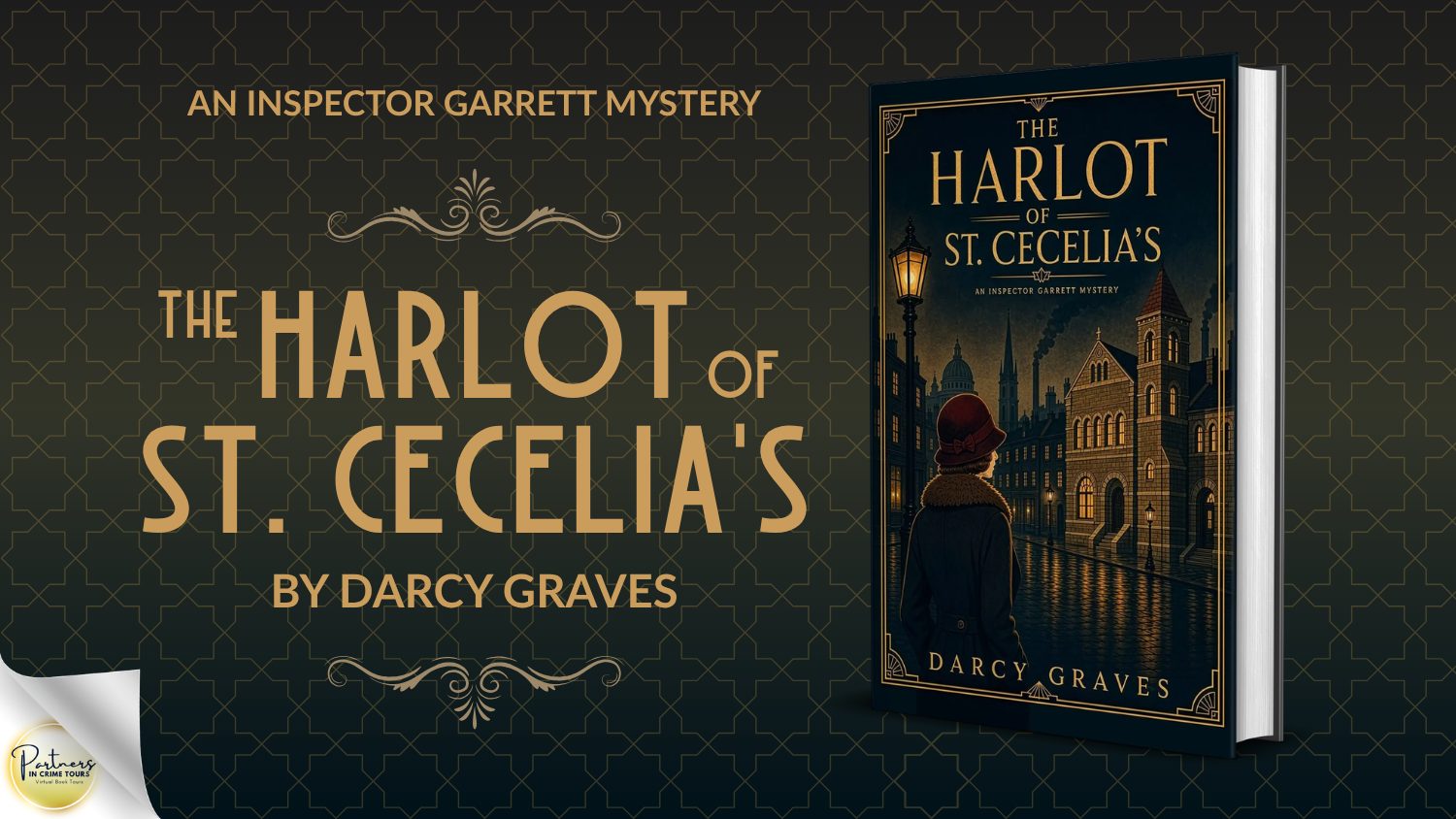
THE HARLOT OF ST. CECELIA'S
by Darcy Graves
September 21 - October 16, 2026 Virtual Book Tour
Synopsis:
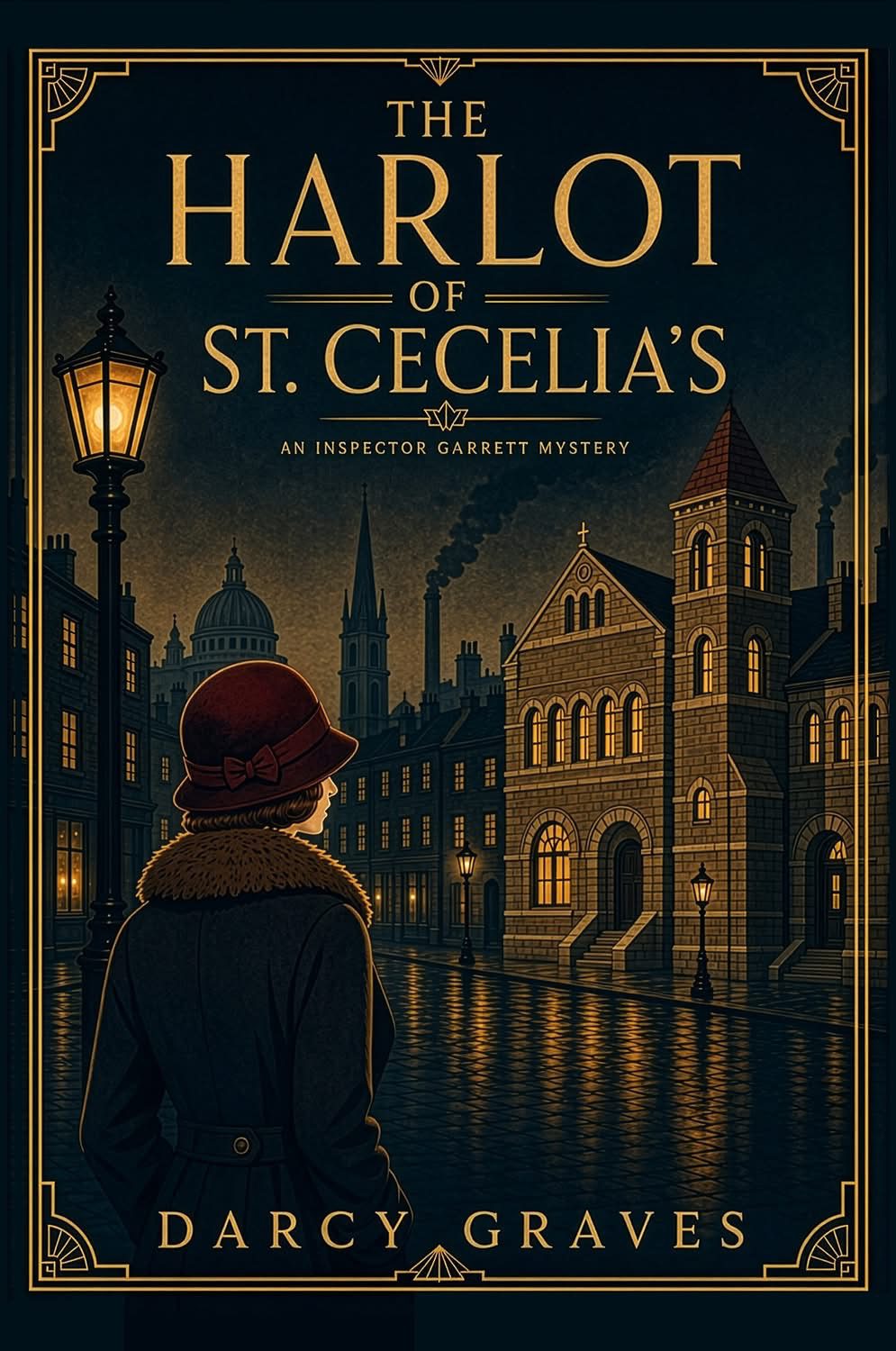
An Inspector Garrett Mystery
London, 1923. American expat librarian Eden Brior thinks things are bad when she is accidentally locked overnight in the St. Cecelia’s Library vault with the charming and unreliable Simon Cross. Then she emerges to find the body of his estranged wife — a celebrated French actress — draped over a chair upstairs.
Detective Inspector William Garrett is methodical, quietly perceptive, and already fairly certain he has his man. He tells Eden firmly to go home and leave the detecting to the professionals. But how can she?
Racing to clear their names before Garrett closes the case, Eden follows the truth from the bright footlights of the London stage through the sleek drawing rooms of Jazz Age society, and into secrets that someone will kill to keep buried.
Steeped in the style of the golden age of detective fiction, The Harlot of St. Cecelia’s captures a London still glittering on the surface and shadowed underneath — where every drawing room hides a secret and every secret has a price.
Perfect for fans of Jacqueline Winspear’s Maisie Dobbs series.
Praise for The Harlot of St. Cecelia's:
"This novel consistently delights, from the spicy title to the last page."
~ Kirkus Reviews
Book Details:
Genre: Historical Mystery
Published by: Independently Published
Publication Date: May 3, 2026
Number of Pages: 306
ISBN: 979-8195315580
Series: Inspector Garrett Mystery Series, Book 1
Book Links: Amazon | Kindle | Barnes & Noble | Goodreads | BookBub
Read an excerpt:
Author Bio:

Darcy Graves grew up in Boston and holds an MA in English history and a BS in copywriting. A marketing content writer for over thirty years, she brings to her work a deep love of the golden age of detective fiction — particularly Agatha Christie and P.D. James — and the whimsy of P.G. Wodehouse.
Darcy lives in the Berkshires with her daughter, two ragdoll cats, and a very naughty terrier named Merial. The Harlot of St. Cecelia's is her first novel.
Catch Up With Darcy Graves:
DarcyGravesAuthor.com
Amazon Author Profile
Goodreads
BookBub - @darcygravesauthor
Instagram - @darcygravesauthor
Tour Participants:
Click through the other tour stops for can’t-miss reviews, insider interviews, exclusive guest posts, and more chances to win!Click here to view the Tour Schedule
Don’t Get Locked Out... Enter for a Chance to Win!
This giveaway is hosted by Partners in Crime Tours for The Harlot of St. Cecelia's. See the widget for entry terms and conditions. Void where prohibited.
THE HARLOT OF ST. CECELIA'S by Darcy Graves | Gift CardCan't see the giveaway? Click Here!

No comments:
Post a Comment