THE SWAMP GHOST by Christi Keating Sumich The First Old New Orleans Bookshop Mystery
Mary Catherine Whitney is at her wits end. Very pregnant, her husband is urging her to rest more and get someone to help around the house, at least part time to cook and help with their two hellion young boys. Something even more interesting comes her way, however. Aiden Doyle is the foreman of the front running crew of ditchers, digging the New Basin Canal. One of his men claimed a blur orb chased him back to camp. The other ditchers said it was a fifolet, a pirate ghost guarding treasure. The next morning the man is dead and the other ditcherers refuse to come back to work. With his job on the line, Aiden follows his fiancée's advice and asks Mrs. Whitney for help. After all, she was clever enough to write that pirate book about Jean Lafitte! With a little help from unexpected places Mary Catherine will set about trying to determine just who, or what, killed the ditcher.
The first Old New Orleans Bookshop Mystery brings back characters from a previous novel. Where LAFITTE LIVES was more of an adventure yarn, THE SWAMP GHOST is distinctly a mystery, a historical cozy one at that! This shift is probably why this book is considered the first in the series, even though we've seen the main characters before. While I really enjoyed LAFITTE LIVES I absolutely adored THE SWAMP GHOST!
Mary Catherine Whitney is a force to be reckoned with! She's loud, opinionated, dramatic, funny, and smart. And she's not about to let being very pregnant in 1833 New Orleans stop her from using her wit, and wiles, to solve a murder! She had me laughing... that scene at the bank!...and her dealings with her neighbor and her boys. I'm laughing again thinking about those scenes. I also love the addition of Henrietta, a perfect match for Mary Catherine. While Tobias takes more of a backseat in this story, his quiet strength is always evident and he's always there when needed, providing love and support.
Delightfully funny with a heady mix of history and adventure THE SWAMP GHOST is an engaging mystery and one of the best books I've read all year.
In 1833, Irish immigrants are hard at work digging the New Basin Canal, a waterway that will connect New Orleans to Lake Pontchartrain. When one of the workers sees a strange blue orb glowing in the swamp at night, he fears it is a Fifolet (fee-foo-lay) guarding Jean Lafitte’s buried treasure. Legend has it that pirates killed a crewman and buried his body with their loot, dooming his ghost to stand guard forever. The next morning, the worker is found dead. The men believe the site is cursed, and Aiden Doyle, the crew's leader, must uncover the truth or risk losing his job. When the newly formed police force refuses to investigate, Aiden seeks help from Mary Catherine Whitney, now renowned throughout New Orleans for her mystery-solving skills after she and her husband, Tobias, unraveled the secrets of the notorious pirate Jean Lafitte and wrote a popular adventure story about it. She’ll need all her cleverness and wit to unlock the secrets of the Fifolet, and she may even need a little help from Lafitte himself.
Continuing characters from Lafitte Lives, The Swamp Ghost is the first in the Old New Orleans Bookshop Mysteries, featuring Mary Catherine Whitney, irascible wife, mother, and amateur sleuth in this charming series set in nineteenth-century New Orleans.
Praise for The Swamp Ghost:
"In The Swamp Ghost, the lovable Mary Catherine Whitney returns to lead readers on a captivating adventure through 1833 New Orleans as she investigates the mysterious death of a troublemaker who died while digging a canal. Word goes out that an evil spirit attacked him. A merry band of helpers joins Mary Catherine to find the true killer — or confirm the evil spirit tale. Along the way, they encounter pirates, gamblers, and drunkards. Once again, Christi Keating Sumich entertains us while immersing us in the sights, sounds, smells, and folklore of New Orleans." ~ Marlie Parker Wasserman, author of First Daughter
"If you love strong-willed women solving spooky mysteries in the heat of the bayou, this book is perfect for you! Introduced to the Whitney family in Sumich's first book, THE SWAMP GHOST expands their world and the mysteries in it. Mary Catherine Whitney is a force to be reckoned with. Even the supernatural can't hide from her investigations." ~ Nicole Asselin, Author of the Minor League Mysteries, Host of Baseball, Books, and Banter podcast.
'In Christi Sumich's new novel featuring the Whitney family, feisty Mary Catherine continues to berate her rambunctious sons and, if I may say, saintly husband, but is now stepping not-so-quietly into the world of the amateur sleuth, with help from her equally acerbic cook, Mrs. Clarke. We return to New Orleans. It's a divided city, where the Creoles and the influx of Irish are vying for economic and political dominance. At the heart of this novel is the death of an Irish "digger," just one of hundreds who are digging a new canal out of a swamp. Was his death a murder, or did a ghost protecting pirate treasure kill him? Although this is your classic who-dun-it, albeit with ghosts and pirates, the background of a city and the plight of immigrants is nicely documented. I'm looking forward to Mary Catherine's next "case"!' ~ Claire M. Johnson, author of the Fog City Noir series
Book Details:
Genre: Historical Mystery Published by: Level Best Books Publication Date: September 22, 2026 Number of Pages: 232 Series: An Old New Orleans Bookshop Mystery, Book 1 Book Links:Amazon | Kindle | Goodreads | BookBub
Read an excerpt:
Swamps Outside of New Orleans 1833
Chapter One
Sean Leery smacked his own cheek with such force that he felt like he was back in Ireland, on the receiving end of a blow in one of his many pub brawls. He missed County Cork and his cottage there. It hadn’t been much, but it was certainly better than his present circumstances, trying to catch some sleep in a sweltering Louisiana swamp. The pitiful cypress log hut that was his temporary home while he was out digging the New Basin Canal offered little comfort and couldn’t keep out the water from the daily rainstorms, let alone the mosquitoes that swarmed him and his fellow diggers.
He wiped a smear of blood from his face, slightly mollified to see this one had a full belly, judging by the sizable blood splatter. Hell, most of it was probably his to begin with, but at least the menace would feast on him no more this evening. Not that it would do much good. Ridding the Louisiana bayous of one mosquito had about the same effect as plucking a snowflake off an avalanche. God, he even missed the snow and cold of his homeland, though he still recalled shivering next to the stove, trying to extract the last bit of warmth from the feeble coal remnants. It was just so hot here. And not only during the day. In the summer, which seemed to last most of the year, it was equally unbearable at night, especially in the swamp. Even now, in October, the air was so thick he felt he needed to chew it before he could breathe it in.
He stretched his feet past the edge of his cot to restore circulation before tucking them back under the mosquito netting. Tomorrow, he’d have to find the hole where they were getting in and stitch it up. Cagey little suckers, they were. They’d weasel their way through the tiniest opening. He flopped onto his side, hoping sleep would envelop him again. He needed to rest if he had any hope of performing the arduous labor his job required. The sooner they finished their digging, the sooner he could high-tail it back to New Orleans and civilization.
Though the working and living conditions were less than ideal, Sean considered himself lucky to be on Aiden Doyle’s digging crew. Aiden was a fair foreman, much better than some of the others. He treated his “ditchers” well, as the men digging out the swamp were called.
They were the lead crew on the project, an ambitious plan by the New Orleans Canal and Banking Company to dig a navigable commercial waterway from Lake Pontchartrain to the American Sector of New Orleans, located behind the Vieux Carré, or the French Quarter, as the Americans called it. The canal was to be six to ten feet deep, sixty yards wide, and six miles long. It was being dug by a workforce composed mainly of Irish immigrants wielding picks, shovels, and wheelbarrows, slowly making their way through the swamps outside the city.
It was dangerous, backbreaking work. Ditchers, even young ones, often did not fare well. Because Irish immigrants were arriving in New Orleans in large numbers and were willing to toil for low wages, the company hired them as “expendable labor,” knowing that excavating mosquito-infested swampland meant losing many workers to yellow fever, cholera, and malaria. Some of the foremen joked that to dig a canal, at least four things were necessary: a shovel, a pick, a wheelbarrow, and an Irishman.
Aiden Doyle was Irish, so Sean supposed that might explain his more compassionate nature. Most bosses wouldn’t have taken on someone as old as Sean, let alone someone with his less-than-stellar reputation. Sean would be forty-two on his next birthday, but he looked far older. Hard living took its toll on a man. So did drinking too much whiskey and trying to live by his wits for too long, especially since he hadn’t been blessed with an abundance of them. His bulbous nose was a testament to his love of drink, and its crookedness to the brawling that generally followed.
Sean also loved cards, and he owed debts to the sort of people who expressed their displeasure at not being promptly reimbursed in unfortunate physical ways. So when his debts began piling up and he feared the threats of bodily harm were no longer mere threats, he sought employment out of sheer necessity. He would work until he could pay the most pressing debts to the most violent of his creditors, then quit and resume his life of gambling, drinking, and enjoying the company of disreputable women. Such was his pattern, and Sean was eager to return to it—if he survived this present job.
Sean flopped onto his back, blowing out a frustrated breath. In addition to the stifling heat and swarming blood suckers, his ability to fall back asleep was being hindered by Darren’s snoring and Murph’s farts. Might as well take a piss while I’m awake.
Sean grunted as he shifted to his feet. They were sore after the day’s labors. Every inch of him hurt, but the worst was his shoulders. They ached and throbbed, adding to his insomnia. He needed to sleep if he was to get up the next day and do more digging. If he couldn’t work, Aiden would have to replace him on his crew. Sean wasn’t keen to find another crew. He didn’t particularly like any of the men he worked with out here in this godforsaken place, but he figured he had less than a month to go before he would have enough money to quit. What could be worse than having to beg your way back onto a job you hated? He needed to tough it out.
He pulled on his boots and left the shack. The sliver of moon did little to dispel the swamp's stygian darkness. As he made his way to the temporary privy the crew had erected, he was careful not to trip over the cypress knees poking out of the semi-solid earth and to avoid any snakes that might be hiding in the tall grass. No doubt there were alligators to avoid as well. He shuddered at the thought of disturbing a sleeping gator as he swatted futilely at the mosquitoes buzzing around his head.
Suddenly, his hand froze in front of his face. Were his eyes playing tricks on him? The sight before him shouldn’t be there. A bright blue orb was dancing in the distance, just beyond a copse of water gum trees. Could it be his imagination? It was easy to think so. After all, this landscape was eerie and otherworldly at night. It occupied a nebulous space between water and earth, always wet and only sometimes solid. The densely packed cypress trees, dripping with tattered Spanish moss that reminded Sean of ghosts caught in the branches, crowded out the sun during the day, making it perpetual dusk at its brightest and forcing the humid air to hover over the swamp dwellers like a hot, moist blanket.
Sean had seen some unusual sights out here, but this went beyond any of them. Could it be the moonlight illuminating some swamp gas? He knew this wasn’t it, but he was desperate for a logical explanation. Sean was not superstitious, unlike some of the men he worked with, fools still clinging to their Irish folklore like a lifeline in this strange place. Yet the sight before him sent chills down his body, straight through his aching arms and into his cramping feet.
What was he looking at? There should not be a blue light shining in front of him out here in the desolate swamp. It was not a fire or a lantern, of that he was certain.
Sean was not a religious man, yet he crossed himself in an unconscious, protective gesture. He needed to get back to the safety of the shack and the other diggers, but fear froze him in place. There was a terrifying moment of stasis, and then the blue orb advanced rapidly toward Sean, as if sensing his presence and locking onto him, preparing to give chase. Sean heard a scream and realized it was coming from his own throat. He turned and ran back through the swamp, trying to stay upright as he stumbled over the cypress knees and deep eddies, all thoughts of sleeping gators and rattlers driven from his mind. He burst into the shack, waking the rest of the crew.
As they rubbed sleep from their eyes and sat up in astonishment, trying to make sense of what was happening, they took in the strange sight before them. Sean Leery, the ornery old bastard they had assumed feared nothing and no one, was gasping for breath, sputtering about something he’d spotted in the swamp. His face was as white as if he’d seen the very devil himself, and a dark, wet spot spread across the front of his breeches where he’d pissed himself.
***
Excerpt from The Swamp Ghost by Christi Keating Sumich. Copyright 2026 by Christi Keating Sumich. Reproduced with permission from Christi Keating Sumich. All rights reserved.
Author Bio:
Christi Keating Sumich holds a PhD in History and a master’s degree in English. Her writing combines her fascination with history with her love of the mystery genre. She is the author of Lafitte Lives (Level Best Books, February 2026), a historical mystery centered on her ancestor, the notorious pirate Jean Lafitte. It is the prequel in the Old New Orleans Bookshop Mysteries, followed by The Swamp Ghost (Level Best Books, September 2026). She is also the author of the short story “The Night Doctor of New Orleans” in Crime Before Our Time (Level Best Books August 2026).
Christi's nonfiction titles include Hauntingly Good Spirits: New Orleans Cocktails to Die For (Wellfleet Press, 2024) and The Brandy Milk Punch (Louisiana State University Press, 2025), both written with her mother, Sharon Keating.
Christi lives just outside New Orleans with her husband and too many pets, as she has a soft spot for “unconventionally attractive” animals in need of homes. She is the mother of three grown children (plus a daughter-in-law). Her claim to fame is being the winningest contestant on Hollywood Squares.
This giveaway is hosted by Partners in Crime Tours for The Swamp Ghost by Christi Keating Sumich. See the widget for entry terms and conditions. Void where prohibited.
I just finished reading The Swamp Ghost by Christi Keating Sumich. This book is the first in the Old New Orleans Bookshop Mystery series and was released last month.
Mary Catherine Whitney is at her wits end. Very pregnant, her husband is urging her to rest more and get someone to help around the house, at least part time to cook and help with their two hellion young boys. Something even more interesting comes her way, however. Aiden Doyle is the foreman of the front running crew of ditchers, digging the New Basin Canal. One of his men claimed a blur orb chased him back to camp. The other ditchers said it was a fifolet, a pirate ghost guarding treasure. The next morning the man is dead and the other ditchers refuse to come back to work. With his job on the line, Aiden follows his fiancée's advice and asks Mrs. Whitney for help. After all, she was clever enough to write that pirate book about Jean Lafitte! With a little help from unexpected places Mary Catherine will set about trying to determine just who, or what, killed the ditcher.
I'm pleased to welcome Bill Cusano to Cozy Up With Kathy today. Bill writes the Old Cranberry Ladies Garden Club Mystery series. THE GHOST AND THE KEY is the first book in the series.
Kathy: In THE GHOST AND THE KEY readers are introduced to The Ladies Garden Club of Old Cranberry, Connecticut. Is this group based on a real organization, or is it completely a product of your imagination?
BC: It is completely a product of my imagination.
Kathy: While a portion of the book takes place in modern times, part goes back 192 years to the founding of the group...and a murder. Did you find writing one time period easier than the other?
BC: I love writing in both periods. When I wrote THE GHOST AND THE KEY, I did not have a series in mind. Elcira inspired me to go back in time and discover her story.
Kathy: The ghost of Elcira Cranberry visits Mildred, the current Cranberry matriarch. Do you believe in ghosts? Have you ever had a paranormal experience?
BC: When I was young, I believed I saw a young girl standing in my bedroom. I was severely nearsighted at the time and she was out of focus, making me wonder if she could have been real. I do believe the Holy Spirit guides us and informs us, so it is possible.
Kathy: What first drew you to cozy mysteries?
BC: I have always been a fan of Agatha Christie, among others who write these mysteries. They are fun.
Kathy: Do you write in any other genres?
BC: The rest of the series is historical fiction. There are still mysteries in them, but I find history intriguing, especially when approached through a family saga like mine. I have written thrillers and dark comedy as well.
Kathy: Tell us about your series.
BC: The Cranberry family has managed to hold onto its property, its dignity and its secrets for nearly two hundred years, across eight generations.The strength lies in the family, with the women being the moral center of the home and the farm, going against the established norms of the time to do what they believe is right..
Kathy: Do you have a favorite character? If so, who and why?
BC: Elcira is my favorite character. She sets the tone and the example for all who follow, right up to the present day with Mildred, her great great granddaughter. Alongside Elcira is Deborah who defies convention and stereotypes. They are hated and despised by the townfolk, while also being quietly admired.
Kathy: Did you have a specific inspiration for your series?
BC: My inspiration was and remains my wife and her love of stories in all genres. She was always supportive of my writing, but she would encourage me to read the books she was reading, telling me I could write like that. I took that as a polite way to tell me how I could get better at my writing.
Kathy: What made you decide to publish your work?
BC: When my wife passed, I wanted to write a book she would have loved to read, and I wanted to publish it by her birthday. To do that, I had to become an independent publisher.
Kathy: If you could have a dinner party and invite 4 authors, living or dead, in any genre, who would you invite?
BC: Edgar Allen Poe would be one, for the tension he created in his stories. Kristin Hannah for all her great stories of strong women and sisters. Lynda Rutledge for the way she turned a true story into an amazing journey in WEST WITH GIRAFFES. And any one of the dozens of talented writers I have met on Substack, including Asteria Geisterblum.
Kathy: What are you currently reading?
BC: I am currently reading submissions for the Claymore Awards which will be presented at the Killer Nashville writers conference in August. These are not yet published novels in a variety of genres, not my own, so I can submit my novels as well.
Kathy: Will you share any of your hobbies or interests with us?
BC: I love to play the piano and am learning to play the violin. I like to take walks and listen to books or music while I do. I have always been fascinated by technology, and I dabble in video production. I used to paint, but haven’t done that in a long while, and I am learning to play bridge.
Kathy: Name 4 items you always have in your fridge or pantry.
BC: Eggs, Butter, Bacon, and English Muffins
Kathy: Do you have plans for future books either in your current series or a new series?
BC: I have plans for more books in the current series. There are a lot of characters whose stories have not yet been told. I have been asked to write a second book in the Jigsaw Man possible series. I have started a couple of other books that could turn into stand alone or series books.
Kathy: What's your favorite thing about being an author?
BC: I started out life as a shy and introverted child. Reading and writing were where I could escape and be me. Over the years, as I developed greater self-confidence and met many interesting people, I continued to write stories inspired by the worlds they introduced me to. I love my characters. I miss them when I am away. They become real to me. Now that I have a voice actress recording their voices for audiobooks, I am blown away. They live.
With a pitchfork through the man's groin and another through his chest, it is clear that someone had murdered Chester H. Cranberry. It's not something that could have happened accidentally. But that was 192 years ago. As Mildred Cranberry, the current family matriarch, puts it, "We have two women, two keys, two pitchforks, and one dead two-timing man." Who in their right mind would want to dig up that cold case and try to solve it? It's not like the murderer could be prosecuted in 2024, right? But what if a key piece of evidence can be dug up (literally)? And what if a descendant of Chester's illegitimate child can get her hands on it? Mildred will need more than the Old Cranberry Ladies Garden Club members to solve this bizarre case. The spiritual support she needs may not be what she expects when the ghost of Elcira Cranberry, the widow murderess herself, arrives to do what? Tell the truth or protect her reputation?
The Ladies Garden Club of Old Cranberry, Connecticut, has a 200-year history that has remained shrouded in secrecy for so long, it has been lost to history, until now. Elcira Cranberry and freedwoman Deborah Townsend knew the men of the town would have no interest in a garden club, so it was the perfect cover for their secret organization. Now, nearly two centuries later, the current members have no idea what those ladies were up to in the early 1800s, right here in Connecticut. But the secret will soon be out.
Dressed in her husband’s shirt, overalls, and boots, to avoid soiling her fine clothing, Elcira Cranberry takes the long way around from the main house to the potting shed at the edge of the carriage house property. She stops to press her face into the down-soft syringa vulgaris, better known as the lilac. Here, bordering the two parcels of land her husband planted all seven colors of the species, one variety each year for each of their children. What a loving thing to do, she had thought, until they started blooming and it became apparent that their spring-like lily of the valley fragrance was the perfect way to overpower the stench from the nearby outhouse. So much for romance. But she enjoyed them, her other children, as she called them, and each year she clips, grafts and coddles a new generation into life, hoping to extend their lives beyond the one-hundred-years they are expected to live.
“Be careful, dear,” he told Elcira when he saw her cradling the flowers to her nose, “some lilacs can be quite toxic.”
“I intend to enjoy every moment of my life with them.”
She steals away to her favorite place and unlocks the potting shed door with a brass key. It occurs to her that, dressed as she is, a passerby or nosy neighbor, like Colonel Townsend, could mistake her for Chester.
Elcira locks the door from the inside and pockets the key. She unbuttons the overalls and lets them drop to the floor. The work shirt becomes a work dress, and its function is to keep her cool.
The sunlight barely sneaks in—a voyeur, a peep, a trickle of light—enough for her to see her potted friends. The scent of lilacs and fresh soil erases all thoughts from her mind. This is her peaceful place. While she works at making a V-shaped cut in the stem of the yellow lilac, a sparrow chirps to her chicks in a nest under the eave of the roof. The nest sits precariously between the crossbeam and the top of the wall. The shed doesn’t offer much protection from the elements, but it provides shade from the sun and some cover from the rain and snow. Mostly, it provides Elcira with an asylum, a place to go to be alone with her thoughts.
“Elcira!” Chester barks. “Where are you? I need something to drink.” She knows he is in the barn again, moving piles of hay from one place to another, pitchfork in hand. He will be loading the hay onto the wagon to bring to the horses. If only the children were old enough to help him, she would have more time to spend with her horses. Theirs is the life, running within their rounded-fenced paddock on the bottom fifty, beyond the hill, drinking from the pond whenever they need refreshment. Why don’t you go down there, stick your head under, and breathe in all you can?
She brushes the dirt from her hands and wipes them on the overalls before stepping back into them. She doesn’t have much time to herself, but at least with Deborah watching the young ones and the older ones at the schoolhouse in town, these few hours are her time unless he calls. At least he’s not twiddling his fingers beneath some young thing’s whalebone corset.
She has thought about hiring one of those newly freed slaves as an all-around domestic as some of Elcira’s garden club ladies have done. No doubt Chester would want to choose one whose looks he fancies. It doesn’t matter to him what the skin looks like. His eyes roam where only modesty and necessity should venture. Freed slaves, like Deborah, do still turn some heads in town, but here,
on the edge of their property, where the Colonel lives, she is safe from wandering eyes and hands. Rumors do make their way from the wagging tongues of the garden club ladies, who are often more reliable than the local newspaper.
Elcira unlocks the potting shed and approaches the well. Deborah is sitting on the ground, her back against the stone well.
“Oh, Mrs. Cranberry. I didn’t expect anyone at this time of day.” Her nose is running, and her eyes look like ladybugs, red and black.
“You didn’t want to be seen. What’s wrong?” Elcira is unaccustomed to involving herself in the affairs of others, but Elcira has known Deborah since she was born. Her mom, Grace, was Colonel Townsend’s slave and nanny to his daughter, Penelope. Now, she is often alone in the house here on the edge of the Cranberry Farm while the colonel is away with his militia. Chester sold this property from the row of lilacs down to the small house to Colonel Townsend for a mangy mule and some seed. One of those neighborly deeds he is famous for, making him look like a true gentleman among all the other “true” gentlemen of this idyllic New England paradise lost.
Deborah places a hand on her belly and starts to cry. Instantly, Elcira understands.
“Who is the father?” Elcira expects her to say it is the colonel, but Deborah puts her head down and wipes her eyes with the hem of her skirt, revealing her legs. Even with her dark skin, Elcira spots remnants of bruises. If this is the twiddler’s work, God help him.
“Elcira! My water!”
“Oh hush, you old hoot!” Elcira reaches for the pail to lower it into the well, but Deborah takes it.
“I’ll do it,” she says.
Elcira grabs Deborah’s hands in hers. Their eyes meet. Neither of them moves. “Did he do this to you?” Elcira asks.
Deborah’s lip quivers. “I’m so sorry, Mrs. Cranberry. I couldn’t stop hi—”
“Hush now.” Elcira reaches for Deborah and hugs her. “I know, I know.”
This was not the first time he’d done it. But this isn’t one of the women who frequent the tavern looking for some company for a price. This is Deborah, her friend.
Elcira tightens her grip on her hands for a moment, taking a deep breath before letting go.
“I’ll take the water to him.” Elcira lowers the rope to fill the pail, her lips tight, pressed against each other as if the pail is too heavy. When she pulls it up, Deborah takes it from her.
“This is something I need to do myself,” she says.
A chill rushes through Elcira. Should she let Deborah confront the man who violated her? Deborah kisses Elcira on the cheek and says,” I’ll be fine. Go back to your lilacs. They will miss you.”
Elcira leans closer and kisses her on the cheek. “I will be in the shed. We can have privacy there.” She hands Deborah the brass key. “Keep it. You can unlock the shed at any time and lock it again from the inside. In case you need to get away by yourself, that is. I do it all the time.”
“What about you?”
“There is another key. I keep it on a hook in the shed, in case I get locked in,” she says, nodding toward the barn. “He won’t miss it.” Elcira walks back to the shed. On the way, she notices that Charley, Colonel Townsend’s horse is tied to a post at the house. Good. Deborah doesn’t have to be alone. She looks up at the barn. Chester wields the pitchfork like a hammer, stabbing bundles of hay to loosen them. Seeds and dust spray the air, glistening against the sun. He wipes his brow, jabs the pitchfork into a bale beside him, plants himself on a throne of hay, and takes the pail of water from Deborah.
Elcira clips a few branches from the white lilac bush near the door and brings them inside. The intoxicating aroma pulls her toward the porcelain white cups of the flower. Several fall off, a sign that the season is waning. Soon all the buds will be cast to the wind and the bushes will go back to serving as a hedge. When the flowers die, time dies with it.
She reaches for the key near the door’s hook. It is missing. It must be in the house.
“Elcira!”
For God’s sake. Leave me be. She grabs the door handle and gives it a turn. It won’t move. It’s locked.
“Deborah!” Elcira calls her name several times, but there is no answer.
***
Excerpt from THE GHOST AND THE KEY by Bill Cusano. Copyright 2025 by Bill Cusano. Reproduced with permission from Bill Cusano. All rights reserved.
Author Bio:
Bill Cusano is an author, a retired deacon in the Episcopal Church and a believer that it is the process rather than the outcomes that matter most in our lives. Retired from the corporate world and an eight-year stint running a non-profit feeding program, Bill attacks every project as a ministry, giving it his full commitment. Needing to readjust to life after losing the love of his life to leukemia in April of 2024, Bill returned to writing full-time, resulting in The Old Cranberry Ladies Garden Club series, the motivation and inspiration for which came from his wife’s voracious appetite for reading historical fiction. While this is Bill’s debut novel, he has always been a writer, publishing short stories and poems early on, and then beginning a daily spiritual blog in 2008. You can follow Bill’s Reflections From The Garden Bench along with other writings on his Substack account.
After the loss of three of his five children to yellow fever Tobias
Whitney sold his bookshop and lived in a miasma of grief. Taking a job
as sexton at St. Louis Cemetery No. 2 Tobias tends to the graves,
appreciating the silence and solitude despite the stench of a New
Orleans summer in 1831. Noticing a bow on the nameplate of one of the
mausoleums Tobias intends to repair it, but finds it hollowed out and a
journal inside. Written in French, a language he is unable to read,
Tobias shares his discovery with his wife. With Mary Catherine
translating, the journal tells the story of Jean Lafitte written by his
step-brother Dominique You. Even better than the adventure yarns he
usually reads, Tobias learns that Lafitte did not die when everyone
believed. The journal reveals many secrets about the legendary man, but
will it also lead to treasure?
I found LAFITTE LIVES to be a fascinating and enjoyable read. However, it's not a mystery in the traditional sense. There's not a crime which Tobias sets out to solve. Rather it's an adventure story with mysterious elements. Indeed, most of the mystery isn't faced by Tobias, but rather the readers themselves. The brilliance is that you don't even truly realize all of the mysteries until the very end, when things click and you enjoy several aha moments!
There are two stories at play here, the life of Jean Lafitte and the story of Tobias and Mary Catherine. I really like both of the Whitneys, but especially the spitfire that is Mary Catherine. Smart, caring, with a fiery temper she will fight for her family as she yells at them. She understands the subtleties of human nature and uses that knowledge to help Tobias, in more than just her translations. While her role is much smaller, I also really like Olivia and how Voodoo is portrayed.
An adventure yarn within a historical mystery LAFITTE LIVES combines the facts, legends, and myths of the legendary pirate with the lives of an Irish family in 1830s New Orleans making a tale both thrilling and captivating. Just remember, never trust a pirate.
Secrets can’t stay buried forever—but maybe some should.
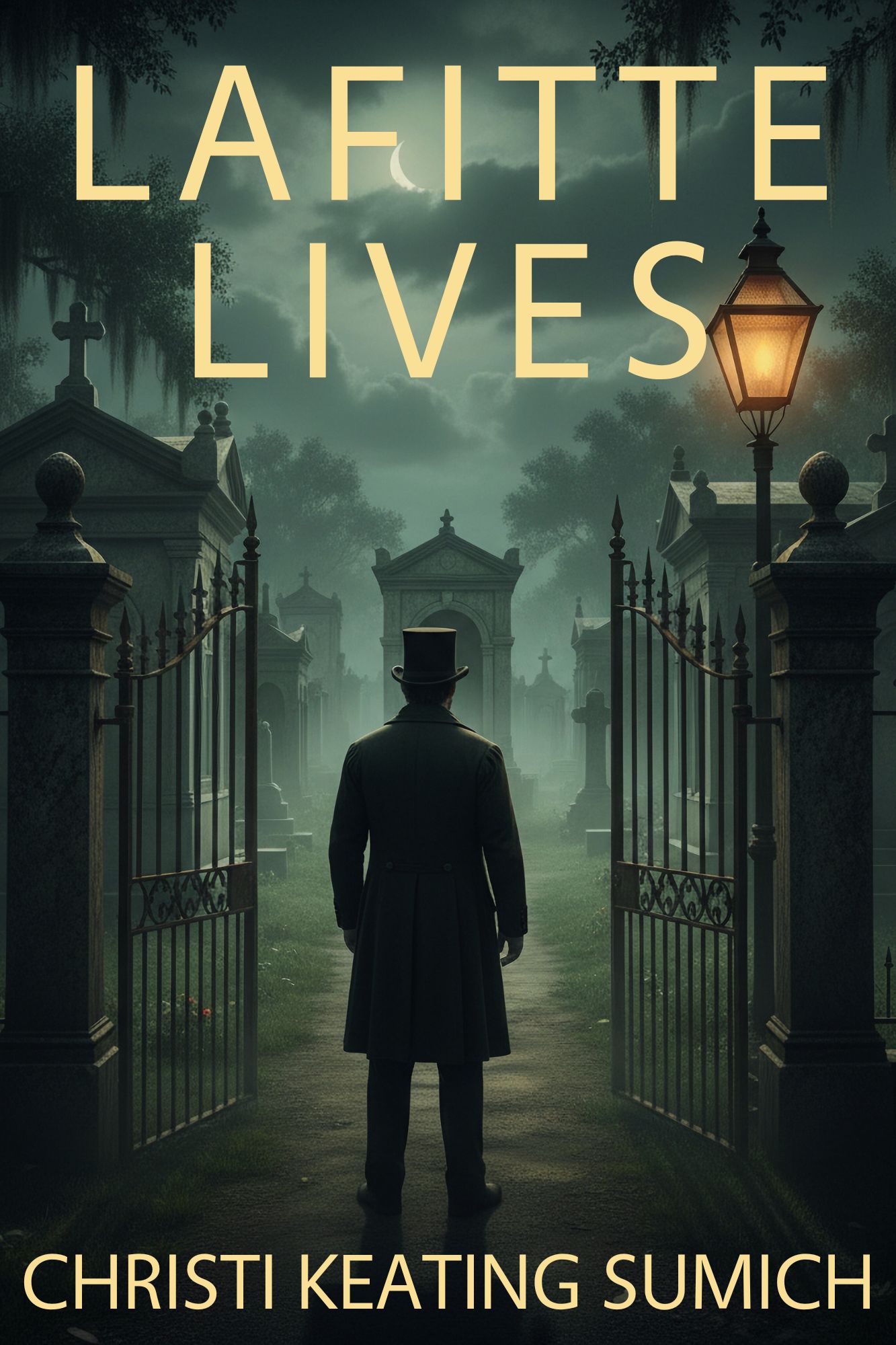
In bustling, multicultural 1831 New Orleans, Tobias Whitney, the sexton of St. Louis Cemetery No. 2, uncovers a journal sealed inside the tomb of Dominique You—war hero of the Battle of New Orleans, privateer, and half-brother of the notorious pirate Jean Lafitte. Convinced that the journal holds the key to Lafitte’s lost treasure, Tobias turns to his sharp-witted and outspoken wife, Mary Catherine, to translate its cryptic French passages.
Tobias and Mary Catherine discover secrets they could not have imagined—secrets that could change their lives forever. But is it really the truth? As the journal warns, Never trust a pirate!
Lafitte Lives blends meticulous historical research with a page-turning mystery, bringing the legend of Jean Lafitte to life while telling the redemptive story of Tobias's grief and Mary Catherine's quest to help him overcome it.
Praise for Lafitte Lives:
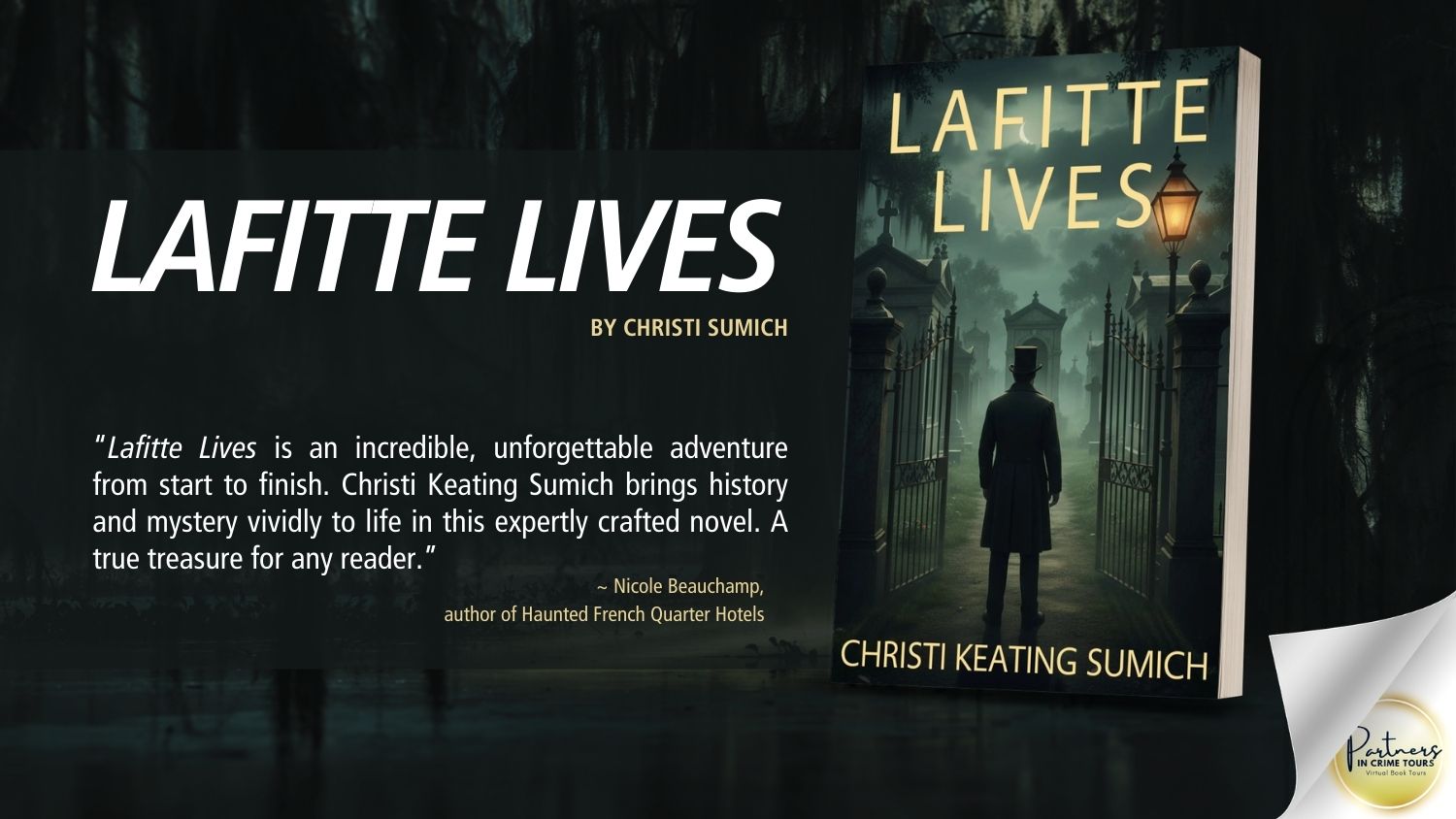
"Lafitte Lives is an incredible, unforgettable adventure from start to finish. Christi Keating Sumich brings history and mystery vividly to life in this expertly crafted novel. A true treasure for any reader." ~ Nicole Beauchamp, author of Haunted French Quarter Hotels
"In August 1831, Tobias Whitney, Sexton—caretaker—of St. Louis Cemetery No. 2 in New Orleans, makes a startling discovery. Hidden in a hollow space in a mausoleum is the diary of Dominique You—half-brother of Jean Lafitte. The diary offers a first-hand account of Lafitte’s life after his reported death in 1823. As the title implies, Lafitte Lives. Find a comfortable seat, grab your favorite beverage, and let your imagination loose as Christi Keating Sumich delivers an engaging tale of the infamous pirate and patriot who may—or may not—have faded into the swamps and bayous of south Louisiana." ~ Michael Rigg, Author of the New Orleans-based medicolegal thriller, Voices of the Elysian Fields
"Lafitte Lives is a ripping good pirate yarn surrounded by a touching story of family heartbreak and healing, all wrapped up in a tantalizing mystery. Steeped in rich period detail, it’s a tale filled with secrets and surprises readers won’t see coming. After all, never trust a pirate!" ~ J.R. Sanders, author of the Shamus Award winning Nate Ross series
The worst part of the job was the smell. A decaying human body releases an oddly distinct scent. It is a horrid mixture of rotting eggs and cabbage, mothballs, feces, and an off-putting garlic-like odor, depending upon the gases released at each stage of decomposition. Being an observant sort of chap, Tobias Whitney was well-versed in the stink of human decay able to discern how far along a body was in the process of decomposition based on the particular aroma the tomb was emitting. It might be a cloying reek or a putrid stench. The time of year was a contributing factor. The hot, humid summer months were the worst. So much rotting flesh in one place combined to produce a nauseating medley of noxious aromas so foul that even Tobias, who spent his days in the cemetery, felt his stomach churn as he inhaled the soupy air.
Tobias had smelled foul odors before, of course. Anyone who lived in New Orleans long enough had. At this time of year, the privy behind his cottage was the stuff of nightmares. A body could get used to almost anything, though. Tobias had taught himself to focus instead on the delicate, honeyed scent of the flowering sweet olive bushes planted in the courtyards of homes all through the Vieux Carré, or the French Quarter as the Americans called it, for the express purpose of making the stench of so many privies in such close proximity more bearable.
Similar aforethought had gone into the landscaping at St. Louis Cemetery No. 2, where Tobias had been sexton for nearly three years. Unfortunately, the ethereal scent of fragrant flowering bushes and trees planted along the perimeter and throughout the cemetery grounds was far too subtle to mask the stink. It invaded his nose and marched its way down to his mouth. He let out a breath he’d been holding and put his sleeve against his nose as he inhaled. He spit to rid himself of the foul taste. Both actions proved futile. It was no wonder. The body interred within the tomb he was cleaning had been laid to rest less than a year before, and the tomb's inhabitant to his right was an even fresher burial.
As sexton, he was responsible for maintaining the cemetery. Some months were busier than others, and August was keeping him at sixes and sevens, between all the yellow fever burials and the rains making a mess of the cemetery pathways. The cemetery had flooded recently, causing the crushed oyster-shell gravel to flow in rivulets between the above-ground tombs and collect in the lowest spot. Unfortunately, the lowest spot was the site of a recently built tomb.
The cemetery consisted mainly of above-ground tombs, whose care kept Tobias busy, though he remained fascinated by the structures. Above-ground burials were the custom here, in part due to the French and Spanish colonists who settled in New Orleans, and for more practical reasons. Guthrie Toups, the octogenarian and retired sexton whom Tobias replaced, had justified the tomb burials in the most colorful fashion.
“These tombs are your bosom friend.” He had waved his gnarled hand about, indicating the structures surrounding him, as he shuffled through the cemetery with Tobias on one of his final days on the job. “Smell like shite in summer but keep the floaters pinned down.” When Tobias failed to comment, Guthrie explained.
“Used to be, I worked at St. Peter Street Cemetery. All those souls went right in the ground. Two times I recall the rainwaters floodin’ the place somethin’ fierce. Coffins poppin’ up like gophers in springtime. Some washed down the street, right up to folks’ houses. When the lids came off, now that was a sight!” A shudder wracked Guthrie’s gaunt frame, rippling through his threadbare coat. “Took us weeks to round up the coffins. And then to find out who belonged where! Can’t put a body back in a hole when you don’t know who he is and which hole is his,” Guthrie shook his head. “Damn shame. You think lookin’ after these tombs is trouble until you gotta put coffins back whence they should never have been disturbed.”
Guthrie, who insisted on being called by his Christian name, had been gone from the cemetery for three years and from the world for two. Technically, he had never actually left St. Louis No. 2. He was enjoying his eternal rest, only one row of tombs over from where Tobias was currently toiling. Tobias considered whether Guthrie’s take on the tradeoff of floaters versus smell was valid. “Shite” seemed far too euphemistic a way to describe what was assailing his senses. Had the souls surrounding him been laid to rest underground, there would be no discernible odor, even in the August heat. However, in addition to being above ground, the vaults in St. Louis No. 2 were not airtight, a necessity since exposure to the elements ensured the bodies would decompose in a timely fashion. Following the bevy of recent rainstorms that Tobias’s wife referred to as “gully washers,” an additional component of stale, stagnant water added to the cemetery effluvium.
"God's teeth!" declared Tobias in frustration, blowing out a breath of putrid air as he gazed at the dispersed gravel and mud piled up along the front and sides of the low-lying tomb. He continued raking, attempting to redistribute the mud-soaked mess along the paths that separated the tombs. It was slow going. The puddles of standing water made the task challenging, and, of course, another drenching rain would produce a similar mess. It was the sort of mindless labor that allowed a person time to think, though Tobias, as of late, preferred not to indulge his brain in aimless wandering. It inevitably led back to dark and painful places. Instead, he compensated by replacing his internal monologue with the voices of others, imagining how they might describe what he was presently seeing. It engaged his mind and allowed him to distance himself from his thoughts. He often remembered the tombs' description, construction, and proper care, as Guthrie had first explained them to him. Even now, he could so vividly recall the old man’s gravelly voice, brittle as the oyster shells underfoot.
“Needed these tombs, the city did. So many coming to New Orleans after Jefferson bought her up, and so many dying here. Nowhere to put a cemetery unless you want to go digging graves in a swamp!” His guffaw had echoed off the tombs.
When Guthrie first began his tutelage, Tobias doubted that he could absorb any new information, so clogged was his brain with other thoughts. Still, the details distracted him. He yearned to learn all he could about the cemetery and the tombs where the bodies rested. He was fascinated, he feared morbidly so, with the amount of sadness one place could contain within its walls. Tobias could sense the pain and loss felt by the loved ones of St. Louis No. 2’s inhabitants, the heaviness of their collective grief threatening to crush him at times. He felt the familiar weight bearing down on him as he looked to his left, at the open tomb whose faceplate had been removed in anticipation of its next occupant, a newly deceased young woman who would be interred there tomorrow. The tomb was empty now, as she would be the first inhabitant.
He took a moment to wipe his brow and allowed himself to be transported back to the first time he had viewed an open tomb.
“‘Nother good thing ‘bout tombs is how many bodies you can stuff inside,” Guthrie had explained.
Tobias had to bend his lanky frame nearly horizontal to match the smaller man’s permanently hunched posture, but by doing so, he could peer into the yawning darkness of the tomb, the unnatural stillness of the space raising the hairs on the back of his neck.
“This one’s a single vault,” Guthrie said. “When the first one of the family dies, we put him in there, coffin an’ all. When the next one goes, that first one gets taken out of the coffin, and what remains of him gets put down in the caveau.” He motioned to the dark, far reaches of the tomb, beyond and below, where the coffin was to be placed. “And so it goes ‘til all the family is holed up in their tomb together. Here’s hopin’ they get along, cuz that’s some close quarters!” Guthrie punctuated this with a cackle and a bony elbow to Tobias’s ribs.
Guthrie’s litany of anecdotes and explanations encompassed nearly every inch of St. Louis No. 2, including the perimeter walls of the cemetery itself, comprised of stacked tombs that Guthrie had told him were called ovens.
“Cuz they look like ovens put one atop the other, and they heat up the bodies faster than cookin’ ‘em. That’s a good thing when you need to get a lot of bodies buried all at once.”
Guthrie’s mood had turned somber, the smile leaving his face. “I can remember stacking bodies up in ‘24 and ‘25 when Yellow Jack came for so many, and there was nary a place to put ‘em. Brought ‘em to the cemetery by the cartload and dumped ‘em right outside the cemetery gates, they did. Left those poor souls rotting in the sun, spreading their miasma over the city like a damned blanket. Least these ovens do the trick!”
The thought of yellow fever victims drew an involuntary shiver from Tobias, even this day, in the summer heat. Guthrie’s voice in Tobias’s head was sometimes the only company he had, not that he was complaining. Tobias craved solitude and was thankful to have this job. It paid a decent wage, enough for his family to live simply but comfortably, and perhaps best of all, it allowed him time to read.
He looked wistfully at his favorite reading bench, positioned in a particularly serene spot deep within the cemetery. The only sounds were the cooing of doves and the whining buzz of cicadas, so incessant this time of year as to become background noise. He felt the book’s weight in his pocket, ever-present and beckoning him to take a break. His vision blurred. He wiped the sweat from his forehead yet again to prevent more of it from dripping into his eyes. He yearned to lose himself, if only for an hour or so, in the all-absorbing action-adventure stories he loved so dearly. For the past few years, escaping from the world had become necessary for his survival. Strange, he often mused, that spending his days surrounded by the dead would be the only way he could cope with the living. Strange, but understandable, given what happened to him three years ago.
With a stubborn shake of his head, he said aloud, though no one else was around, “Not ‘til I put this tomb to rights.” Most families who owned vaults cared for them or paid the cemetery to perform the maintenance, which at the very least required replastering and whitewashing the brick from time to time. Even though the cemetery was relatively new, consecrated only eight years ago, he could already see the ravages the subtropical climate wreaked on those tombs without a caretaker to maintain them.
“Orphan tombs, these ones are,” Guthrie had said of the tombs left to crumble. “Got no livin’ kin to care for ‘em.” He had shaken his head, the wiry gray hairs swaying with the movement. “A whole family gone and no one to remember them.”
Tobias considered Guthrie’s words as worked this day. As he raked, he looked over his shoulder at one such orphan tomb and read aloud the inscriptions on the faceplate, “Constance Bulwark, born 1770, died 1824. Faithful wife, loving mother. ‘Blessed are the pure in heart, for they shall see God.’ Jeremiah Longstreet, born 1758, died 1827. Honest in labor, kind in spirit. May his soul rest in peace.” To preserve the dignity of the inhabitants within, he cleaned and made minor repairs to the orphan tombs, though it was technically beyond the purview of his duties. “You’ll not be forgotten,” he assured them before turning his attention to the task at hand.
The tomb before him was not an orphan, as the cemetery was contracted to maintain it, but it might as well have been. Its inhabitant had received no visitors since he was laid to rest. Still, this particular tomb had intrigued Tobias since its construction last November. Like most in St. Louis No. 2, it was brick. While not as extravagant as some tombs Tobias had seen, he found the elevated parapet facade aesthetically pleasing in a simple, elegant way. However, the feature that most fascinated him was the nameplate commemorating the occupant, Dominique You. You was a Freemason, as such, his tomb sported the square and compass symbol prominently carved into the top of the marble nameplate. Below the name was an inscription in French. Tobias was Irish and could not discern the writing, but he knew from the accounts he had read in the papers that the inscription was from Voltaire’s La Henriade:
Intrepid warrior on land and sea
in a hundred combats showed his valor.
This new Bayard without reproach or fear
Could have witnessed the ending of the world without trembling.
Dominique You was an infamous privateer and, some say, the half-brother of the notorious pirate Jean Lafitte. Tobias had read all about the adventures of the two buccaneer brothers in the weekly broadsheets he purchased. Lafitte had been killed in 1823, the same year St. Louis No. 2 opened. But while Lafitte’s whereabouts in the years before his death remained a mystery, Dominique You had lived out his final years in New Orleans, keeping a tavern and serving on the city council. He may have been a privateer, but he was also a war hero, having served valiantly as a gunner in the Battle of New Orleans, warding off a British invasion of the city by commanding a company of artillery composed of fellow pirates.
Stories about Dominique You and Jean Lafitte were legendary around New Orleans and made the adventure novels Tobias read pale in comparison. Tobias vividly recalled his excitement when Dominique You was buried right in front of where he was now standing. Although You died in a state of penury, the people of New Orleans did not forget his heroism. He was given a lavish funeral at the Cathedral of St. Louis, with full military honors, the likes of which the city had seldom seen. Throngs of mourners had followed the coffin to the cemetery. As the sexton, Tobias had been there to witness it all.
Many brought flowers to lay on his tomb, chrysanthemums or early-blooming camellias. Others brought magnolia leaves, fashioned into wreaths or dried herbs tied into bouquets with bits of ribbon or string. There were also rosaries, little vials of holy water, candles, and voodoo tokens left on You’s tomb. The mourners were as varied as the offerings they brought, well-dressed gentlefolk alongside the more common sort. They were all here for the same reason: to pay their respects to the man who helped save the city from the British fifteen years before.
Tobias had caught snippets of conversations all around the tomb. One, in particular, stayed with him. A group of rough-looking men, ill at ease in their mourning attire, had gathered at You’s tomb.
One of the men said, “Sailed with him, I did. No finer man you'd want at your side when things turned hairy. I’d trust him with my life."
"As would I," his mate agreed. "Fought beside him, too. Best cannoneer I ever saw. That’s why the general said he’d storm the gates of hell with Dominique as his lieutenant!”
Tobias had been particularly impressed with this, considering General Andrew Jackson was now president of the United States. He watched as they poured a slug of rum next to the tomb. It soaked into the gravel, leaving the scent of molasses and cloves lingering in the air like a final tribute. Tobias wondered with a shudder if these men were pirates themselves.
He’d had little time to dwell on it, as a Mason engaged him in conversation shortly after Tobias overheard this exchange. The man donned a fine wool suit, well cut and fashionable, with a frock coat that gracefully skimmed the back of the knees of his trousers. Tobias usually donned a working man’s attire for his days in the cemetery, loose-fitting tweed trousers and a jacket, although on this day, he donned a suit. It was one he used to wear as a shop owner before he became a cemetery sexton, though now he donned it only for Sunday Mass. His wife, Mary Catherine, would have his hide if he showed up to work on the day of an interment of such prominence in anything less. Tobias felt rather nattily clad until he beheld the sartorial superiority of the man. Despite their difference in clothing, the Freemason was eager to engage Tobias in conversation, and Tobias found this agreeable.
Funny how he spoke to almost no one these days, save his family and his close friend, the proprietor of his beloved bookshop, Chapter and Verse. Yet within the walls of the cemetery, he came back to life, if only for a short time. He felt at home here as much as he did in his cottage on Bienville Street. Though he knew precisely why this was, he found it a disconcerting aspect of his personality that he was more comfortable with mourners than with those unaffected by death.
“Not a business in New Orleans stayed open today. Everyone’s here to pay their respects,” the man told Tobias. “I suppose you heard the cannons fired for him?”
Tobias assured him that he had, and added that he’d also noticed the flags flown at half-mast.
The Mason nodded.
“He was a proud man, Dominique You.” The man seemed uneasy in the cemetery, as Tobias found most people to be. He suspected the Mason’s attempts to converse stemmed from a compelling need to fill the silence. Tobias noticed the man’s unconscious fidgeting with the intricately designed collar that nestled just below the tie on his starched white linen shirt, the adornment an indicator of his status among the Brotherhood. He spoke with a French accent, and his eyes told the story of a man who accepted the inevitable tribulations of life while still finding joy in living. Tobias was immediately envious of him.
“Had not a penny to his name at the end but did not tell a soul of his troubles.” The man gazed wistfully at Dominique’s tomb.
Tobias would have left him to his thoughts, but he continued. “We would have come to his aid, I can assure you of that. But Dominique was never one for charity. Tough old sailors rarely are. At least we could honor him in this way.” With a tip of his top hat by his white-gloved hand, the man moved on, presumably finding Tobias too taciturn.
Yet for all the military fanfare and grandeur surrounding the funeral, now, a mere nine months later, the tomb lay quiet. Tobias had seen no visitors at the tomb since that day. Dominique You had never married, and although he had been a rather upstanding citizen in the twilight of his life, he did not appear to have close friends, at least not that Tobias had seen. Close friends visited a grave from time to time, but not even his brothers from the Masonic lodge had come. And those had been the folks most upset by his death, at least if public grieving was any indication. Then again, Tobias had seen a lot of grief in his tenure at the cemetery, and it had been his observation that even members of the sterner sex could make an enormous fuss over the coffin and then never come back.
The people who looked the most distraught, as if they did not care to go on living, usually got over it by morning. It was the ones who never took their eyes off the coffin, even as it made its way into the vault, that you could be sure would put flowers there for years. Real grief was mostly invisible. It consumed a person from within, leaving only an outer shell that appeared to the world as a whole being, but was hollow inside. Tobias ought to know. He recognized it in others because he was just a shell himself.
Tobias wondered once again why the Freemasons had chosen this spot for You’s tomb. It seemed a poor location in the cemetery to build a tomb, but it was not Tobias’s place to say so. It was kind of the Freemasons to construct it for their brother, even if they had decreed it was to be sold in fifty years. This stipulation did not surprise him, as he knew people sometimes purchased tombs this way. The odd part to him was that an entire tomb would be dedicated to only one person when many held multiple family members.
Tobias would have thought a single man with no surviving family, and one who did not have much money, would not need a whole tomb to himself. But perhaps his contribution as a war hero had moved some hearts to loosen their purse strings and fund this stand-alone vault. This was a monument to Captain Dominique You, and Tobias would do his part to honor his memory by mucking out the mess around the man’s final resting place.
He finished raking the gravel around the front, repositioning it as best he could amid the puddles that stubbornly lingered even with the scorching August sun. Now he moved to the side of the tomb, where the ground was slightly lower, causing even more water to pool. He could not do much else until the water drained, which might take a while in New Orleans. In the meantime, he could wipe away some of the mud that had splashed onto the tomb from the rainstorm. He pulled a clean rag out of his pocket and decided to concentrate on the nameplate on the front of the tomb.
It was then that Tobias noticed the oddest thing—the marble plate was not flush against the bricks. Tobias chided himself for not observing this before, but as he studied it closely, he realized that it appeared to be placed properly from the front. It was not until he looked from the side that he could see the marble stone was bowing. This was indeed curious, as he himself had placed the outer tablet. As sexton, it was part of his duties to affix the plate upon the bricks after the body was interred and the tomb bricked up.
He had seen marble bow when exposed to extreme heat, but thick nameplates typically did not deform so quickly. It was a blessing in disguise that the rain, which would inevitably flood the cemetery in the summer months, had necessitated him spending time around this tomb, allowing him to observe it more closely. Had the Freemasons chosen a more optimal spot to place the tomb, it might have been many years before he had noticed this subpar workmanship. And since the inhabitant had no living family members, it might not have been until the fifty years were up and the sexton opened the tomb for a new burial that the faulty nameplate was discovered.
But surely, he would have noticed if something was amiss with the marble. He leaned in for a closer inspection and blinked rapidly. He thought perhaps it was a trick of the bright sunshine, but as he stared at the marble slab, he discerned a hairline fracture running the length of the stone. Dominique had been interred less than a year ago. This nameplate should not display such signs of degradation. Had he somehow damaged the stone when bolting the nameplate onto the brick vault? Utterly perplexed, Tobias pondered what he should do. He was exceedingly curious whether his workmanship was to blame for the bowing and cracking or if it was a defect in the stone itself.
He knew he should probably wait until he had help, but his inquisitive nature got the best of him, and he rushed off to retrieve his wrench. Removing the large bolts holding the nameplate in place would not be an easy job to perform by himself. He half-expected that he would not be able to loosen them at all, but was relieved and more than a bit surprised to find them coming loose without even having to apply heat. He knew the stone would be too heavy to maneuver on his own, but he planned to slide it down to the ground once it was free from the brick on the front of the vault. With less effort than should have been required for such an undertaking, Tobias freed the marble slab and eased it down about a foot until it rested upright against the tomb. To conduct a proper inspection, he would need to see the back of the slab. The stone was indeed heavy and should have been cumbersome for two men to handle, yet Tobias was able, with some difficulty, to lay the slab on the ground so that the back was visible.
He instantly understood why he was able to maneuver it unassisted. The back of the marble had been carved out, and the stone, too thin in the center to withstand the intense heat, had bowed as a result. The thinned-out stone also accounted for the hairline fracture Tobias had noticed. This nameplate was not the solid, thick slab he had affixed to Dominique’s vault nine months ago. The slab had been altered and reattached, unbeknownst to him. Tobias did not need to ponder why someone had done this because nestled within the carved-out space was a book.
***
Excerpt from Lafitte Lives by Christi Sumich. Copyright 2026 by Christi Sumich. Reproduced with permission from Christi Sumich. All rights reserved.
Author Bio:
Christi Keating Sumich holds a PhD in history from Tulane University and a master’s degree in English. Her research field is seventeenth-century disease and healing.
Christi’s writing combines her fascination with history with her love of the mystery genre. Her debut novel, Lafitte Lives (Level Best Books, March 2026), is a historical mystery centered on her ancestor, the notorious pirate Jean Lafitte. She is also the author of the Old New Orleans Bookshop Series, mysteries featuring characters from Lafitte Lives. The Swamp Ghost is the first book in the series (Level Best Books, September 2026).
Christi is also part of a writing team with her mother, Sharon Keating. They are the co-authors of Hauntingly Good Spirits: New Orleans Cocktails to Die For (Wellfleet Press, 2024) and The Brandy Milk Punch (Louisiana State University Press, 2025), part of the Iconic New Orleans Cocktail Series.
I'm currently reading Lafitte Lives by Christi Keating Sumich. This historical mystery was released earlier this year.
After the loss of three of his five children to yellow fever Tobias Whitney sold his bookshop and lived in a miasma of grief. Taking a job as sexton at St. Louis Cemetery No. 2 Tobias tends to the graves, appreciating the silence and solitude despite the stench of a New Orleans summer in 1831. Noticing a bow on the nameplate of one of the mausoleums Tobias intends to repair it, but finds it hollowed out and a journal inside. Written in French, a language he is unable to read, Tobias shares his discovery with his wife. With Mary Catherine translating the journal tells the story of Jean Lafitte, written by his step-brother Dominique You. Even better than the adventure yarns he usually reads, Tobias learns that Lafitte did not die when everyone believed. The journal reveals many secrets about the legendary man, but will it also lead to treasure?
I'm pleased to welcome Christi Sumich to Cozy Up With Kathy today. Christi's latest release is LAFITTE LIVES.
Kathy: LAFITTE LIVES tells the story of Tobias Whitney and his wife Mary Catherine who discover the journal of Dominique You—war hero of the Battle of New Orleans, privateer, and half-brother of the notorious pirate Jean Lafitte. Do you keep a journal?
CS: Sort of—I keep a running commentary in my head of what I’m doing and how I’m feeling. (It’s weird, but I’ve always done it, so it comes naturally now.) I did keep a physical diary when I was younger. I should probably go back and read it sometime. The last time I glanced at it, I remember thinking it was the cringiest thing I had ever read.
Kathy: Tobias believes the journal holds the key to Lafitte’s lost treasure. Have you ever gone treasure hunting?
CS: Only if you count searching for shells on the beach!
Kathy: Historical mysteries require an extra special brand of research. What's your favorite method to research this time period?
CS: I have a PhD in history, so the research component is critically important to me. When I began researching Jean Lafitte, it quickly became apparent that Lafitte scholars disagree on even the most basic aspects of his life, such as where he was born, when he was born, and when he died. I read the scholars who disagreed most vehemently about his life and juxtaposed their accounts to decide which I wanted to go with. This is where writing fiction feels freeing because I can pick and choose the accounts that best help me tell the story I want to tell.
Kathy: Before writing this novel did you know a lot about Lafitte? Was there anything in your research that really surprised you?
CS: I did. It’s hard to grow up in New Orleans without knowing about Jean Lafitte. There are streets, bars, hotels, and towns named after him. Plus, according to family legend, Lafitte is an ancestor. My mother’s grandmother was a Saint Amant and owned land in Barataria, supposedly land inherited from Captain Jean Lafitte, through an illegitimate branch of the family.
I also grew up with documents written by Jean Lafitte hanging up in my parents’ house. My paternal grandfather had done some business in London and was repaid with papers written by Jean Lafitte, which he gave to his daughter-in-law (my mother) because of her supposed connection to the man. My parents had them framed and hung them on the wall in our dining room. When I asked about them, my parents told me they were “a legal contract to do something illegal.” The papers delineated the terms and conditions under which one of his privateering captains could commandeer ships. They outlined in meticulous detail what would happen and how the spoils would be divided, leaving nothing to chance.
Those papers were in the background of my life as I was growing up. They were written in French, so I couldn't understand them, but I can still picture his signature and the date, 1805. They came to symbolize mystery and adventure for me.
What surprised me the most about my research was the lack of consensus about his life. I have come to the conclusion that, as a privateer, it was in his best interest to have the details of his life remain murky. As a character says in the book, his name is his treasure, and he does not wish to share it. Jean Lafitte did an excellent job guarding that particular treasure.
Kathy: What first drew you to historical mysteries?
CS: I absolutely love history. I think it’s fascinating, which is why I decided to become a historian. I also think the way history is presented can make all the difference in engendering a love of history in others. I’ve always approached teaching history with this idea in mind. To me, novels are magic—they transport us to another time and place. Historical mysteries combine the elements I most love about reading and history. We get to glimpse another era and see the world from a completely different perspective. There’s something about that perspective shift that actually changes the way we view our own loves and the time period we are living in. Did I mention it’s magical? On top of that, we get to solve a mystery! It’s the perfect genre.
Kathy: Do you write in any other genres?
CS: Yes! In addition to my scholarly work, I have written two cocktail history books with my mom. Hauntingly Good Spirits: New Orleans Cocktails to Die For (Wellfleet Press, August 2024) and The Brandy Milk Punch (Louisiana State University Press, March 2025), part of the Iconic New Orleans Cocktail Series. They are both New Orleans-themed. We had so much fun researching and writing them!
Kathy: Tell us about your book.
CS: In 1831 New Orleans, Tobias Whitney, the sexton of St. Louis Cemetery No. 2, uncovers a journal sealed inside the tomb of Dominique You—war hero of the Battle of New Orleans, privateer, and half-brother of the notorious pirate Jean Lafitte. Convinced that the journal holds the key to Lafitte’s lost treasure, Tobias turns to his sharp-witted and outspoken wife, Mary Catherine, to translate its cryptic French passages. Tobias and Mary Catherine discover secrets they could not have imagined—secrets that could change their lives forever. But is it really the truth? As the journal warns, Never trust a pirate!
Do you have a favorite character? If so, who and why?
CS: I feel like I should say no, because it’s like picking a favorite child, but I do. It’s Mary Catherine Whitney. I really loved writing her. She's spunky, but she has heart. (And for the record, I do not have a favorite child, although I admit to liking one better than the others depending upon the day.)
Kathy: Did you have a specific inspiration for your series?
CS: Those mysterious Lafitte papers hanging in my parents’ dining room were my inspiration. When I wrote LAFITTE LIVES, I intended it to be a standalone. After I finished it, I couldn't shake the sensation that I wasn't done with the characters. I guess it would be fair to say that Mary Catherine inspired the Old New Orleans Bookshop Mysteries. They take place immediately after the conclusion of LAFITTE LIVES and focus on Mary Catherine and her mystery-solving abilities. The first one is THE SWAMP GHOST. It will be released in September.
Kathy: What made you decide to publish your work?
CS: After my mother and I wrote our cocktail books, I wanted to try my hand at fiction. I always knew I would try the traditionally published route because it was the only path to publication I had experience with. I wanted to get my story out to as many people who might enjoy it as I could. Had I not found a publisher, I would have self-published it. I was determined it would not live on my computer forever!
Kathy: If you could have a dinner party and invite 4 authors, living or dead, in any genre, who would you invite?
CS: I’m a huge Faulkner fan, so he would be on my list. I don't care much for Hemingway's work, but I think he would be fun at a party, so he could come. Then I would say Anne Rice, so we could chat about New Orleans. Finally, Theodor Seuss Geisel (Dr. Seuss), because he’s iconic, and I could thank him in person for writing GREEN EGGS AND HAM. It’s the book that taught me how to read. I memorized the story, then matched the words in my head to the ones on the pages.
Kathy: What are you currently reading?
CS: I just read PENDERGAST: THE BEGINNING by Douglas Preston and Lincoln Child. I love the series! I am very late to the party, but I just read REMARKABLY BRIGHT CREATURES. It blew me away.
Kathy: Will you share any of your hobbies or interests with us?
CS: Besides reading, I love to travel. Exploring a new place, learning its history, and seeing the world from a new perspective are so appealing to me. But I'm an enigma, because I’m also a homebody. I love a family game night or an afternoon in the pool with my favorite people.
Kathy: Name 4 items you always have in your fridge or pantry.
CS: Eggs, tortillas, berries, coffee
Kathy: Do you have plans for future books?
CS: Absolutely! I’ve finished THE SWAMP GHOST and am working on the third book in the Old New Orleans Bookshop Mysteries. In addition to those, I have written the first in a series of paranormal culinary cozy mysteries with my mom. They are set in modern-day New Orleans, but each has a historical element (that’s the paranormal part). I’ve really enjoyed writing the humor and including recipes. We have an agent for that series, so we’re not sure who will publish it or when it will come out, but we are working on books two and three right now.
Kathy: What's your favorite thing about being an author?
CS: Working from my chair in the living room or, when the weather is nice, on my back porch, with my two dogs and my cat cuddled up next to me. I love writing. I suppose it may get tedious at some point, but I look forward to opening my laptop and getting to work. I’m still amazed at the stories and characters that come out of my head. Transforming a blank Google Doc into a novel is nothing short of magic. I am so grateful to be given the chance to do it!
Secrets can’t stay buried forever—but maybe some should.
In bustling, multicultural 1831 New Orleans, Tobias Whitney, the sexton of St. Louis Cemetery No. 2, uncovers a journal sealed inside the tomb of Dominique You—war hero of the Battle of New Orleans, privateer, and half-brother of the notorious pirate Jean Lafitte. Convinced that the journal holds the key to Lafitte’s lost treasure, Tobias turns to his sharp-witted and outspoken wife, Mary Catherine, to translate its cryptic French passages.
Tobias and Mary Catherine discover secrets they could not have imagined—secrets that could change their lives forever. But is it really the truth? As the journal warns, Never trust a pirate!
Lafitte Lives blends meticulous historical research with a page-turning mystery, bringing the legend of Jean Lafitte to life while telling the redemptive story of Tobias's grief and Mary Catherine's quest to help him overcome it.
Praise for Lafitte Lives:
"Lafitte Lives is an incredible, unforgettable adventure from start to finish. Christi Keating Sumich brings history and mystery vividly to life in this expertly crafted novel. A true treasure for any reader." ~ Nicole Beauchamp, author of Haunted French Quarter Hotels
"In August 1831, Tobias Whitney, Sexton—caretaker—of St. Louis Cemetery No. 2 in New Orleans, makes a startling discovery. Hidden in a hollow space in a mausoleum is the diary of Dominique You—half-brother of Jean Lafitte. The diary offers a first-hand account of Lafitte’s life after his reported death in 1823. As the title implies, Lafitte Lives. Find a comfortable seat, grab your favorite beverage, and let your imagination loose as Christi Keating Sumich delivers an engaging tale of the infamous pirate and patriot who may—or may not—have faded into the swamps and bayous of south Louisiana." ~ Michael Rigg, Author of the New Orleans-based medicolegal thriller, Voices of the Elysian Fields
"Lafitte Lives is a ripping good pirate yarn surrounded by a touching story of family heartbreak and healing, all wrapped up in a tantalizing mystery. Steeped in rich period detail, it’s a tale filled with secrets and surprises readers won’t see coming. After all, never trust a pirate!" ~ J.R. Sanders, author of the Shamus Award winning Nate Ross series
The worst part of the job was the smell. A decaying human body releases an oddly distinct scent. It is a horrid mixture of rotting eggs and cabbage, mothballs, feces, and an off-putting garlic-like odor, depending upon the gases released at each stage of decomposition. Being an observant sort of chap, Tobias Whitney was well-versed in the stink of human decay able to discern how far along a body was in the process of decomposition based on the particular aroma the tomb was emitting. It might be a cloying reek or a putrid stench. The time of year was a contributing factor. The hot, humid summer months were the worst. So much rotting flesh in one place combined to produce a nauseating medley of noxious aromas so foul that even Tobias, who spent his days in the cemetery, felt his stomach churn as he inhaled the soupy air.
Tobias had smelled foul odors before, of course. Anyone who lived in New Orleans long enough had. At this time of year, the privy behind his cottage was the stuff of nightmares. A body could get used to almost anything, though. Tobias had taught himself to focus instead on the delicate, honeyed scent of the flowering sweet olive bushes planted in the courtyards of homes all through the Vieux Carré, or the French Quarter as the Americans called it, for the express purpose of making the stench of so many privies in such close proximity more bearable.
Similar aforethought had gone into the landscaping at St. Louis Cemetery No. 2, where Tobias had been sexton for nearly three years. Unfortunately, the ethereal scent of fragrant flowering bushes and trees planted along the perimeter and throughout the cemetery grounds was far too subtle to mask the stink. It invaded his nose and marched its way down to his mouth. He let out a breath he’d been holding and put his sleeve against his nose as he inhaled. He spit to rid himself of the foul taste. Both actions proved futile. It was no wonder. The body interred within the tomb he was cleaning had been laid to rest less than a year before, and the tomb's inhabitant to his right was an even fresher burial.
As sexton, he was responsible for maintaining the cemetery. Some months were busier than others, and August was keeping him at sixes and sevens, between all the yellow fever burials and the rains making a mess of the cemetery pathways. The cemetery had flooded recently, causing the crushed oyster-shell gravel to flow in rivulets between the above-ground tombs and collect in the lowest spot. Unfortunately, the lowest spot was the site of a recently built tomb.
The cemetery consisted mainly of above-ground tombs, whose care kept Tobias busy, though he remained fascinated by the structures. Above-ground burials were the custom here, in part due to the French and Spanish colonists who settled in New Orleans, and for more practical reasons. Guthrie Toups, the octogenarian and retired sexton whom Tobias replaced, had justified the tomb burials in the most colorful fashion.
“These tombs are your bosom friend.” He had waved his gnarled hand about, indicating the structures surrounding him, as he shuffled through the cemetery with Tobias on one of his final days on the job. “Smell like shite in summer but keep the floaters pinned down.” When Tobias failed to comment, Guthrie explained.
“Used to be, I worked at St. Peter Street Cemetery. All those souls went right in the ground. Two times I recall the rainwaters floodin’ the place somethin’ fierce. Coffins poppin’ up like gophers in springtime. Some washed down the street, right up to folks’ houses. When the lids came off, now that was a sight!” A shudder wracked Guthrie’s gaunt frame, rippling through his threadbare coat. “Took us weeks to round up the coffins. And then to find out who belonged where! Can’t put a body back in a hole when you don’t know who he is and which hole is his,” Guthrie shook his head. “Damn shame. You think lookin’ after these tombs is trouble until you gotta put coffins back whence they should never have been disturbed.”
Guthrie, who insisted on being called by his Christian name, had been gone from the cemetery for three years and from the world for two. Technically, he had never actually left St. Louis No. 2. He was enjoying his eternal rest, only one row of tombs over from where Tobias was currently toiling. Tobias considered whether Guthrie’s take on the tradeoff of floaters versus smell was valid. “Shite” seemed far too euphemistic a way to describe what was assailing his senses. Had the souls surrounding him been laid to rest underground, there would be no discernible odor, even in the August heat. However, in addition to being above ground, the vaults in St. Louis No. 2 were not airtight, a necessity since exposure to the elements ensured the bodies would decompose in a timely fashion. Following the bevy of recent rainstorms that Tobias’s wife referred to as “gully washers,” an additional component of stale, stagnant water added to the cemetery effluvium.
"God's teeth!" declared Tobias in frustration, blowing out a breath of putrid air as he gazed at the dispersed gravel and mud piled up along the front and sides of the low-lying tomb. He continued raking, attempting to redistribute the mud-soaked mess along the paths that separated the tombs. It was slow going. The puddles of standing water made the task challenging, and, of course, another drenching rain would produce a similar mess. It was the sort of mindless labor that allowed a person time to think, though Tobias, as of late, preferred not to indulge his brain in aimless wandering. It inevitably led back to dark and painful places. Instead, he compensated by replacing his internal monologue with the voices of others, imagining how they might describe what he was presently seeing. It engaged his mind and allowed him to distance himself from his thoughts. He often remembered the tombs' description, construction, and proper care, as Guthrie had first explained them to him. Even now, he could so vividly recall the old man’s gravelly voice, brittle as the oyster shells underfoot.
“Needed these tombs, the city did. So many coming to New Orleans after Jefferson bought her up, and so many dying here. Nowhere to put a cemetery unless you want to go digging graves in a swamp!” His guffaw had echoed off the tombs.
When Guthrie first began his tutelage, Tobias doubted that he could absorb any new information, so clogged was his brain with other thoughts. Still, the details distracted him. He yearned to learn all he could about the cemetery and the tombs where the bodies rested. He was fascinated, he feared morbidly so, with the amount of sadness one place could contain within its walls. Tobias could sense the pain and loss felt by the loved ones of St. Louis No. 2’s inhabitants, the heaviness of their collective grief threatening to crush him at times. He felt the familiar weight bearing down on him as he looked to his left, at the open tomb whose faceplate had been removed in anticipation of its next occupant, a newly deceased young woman who would be interred there tomorrow. The tomb was empty now, as she would be the first inhabitant.
He took a moment to wipe his brow and allowed himself to be transported back to the first time he had viewed an open tomb.
“‘Nother good thing ‘bout tombs is how many bodies you can stuff inside,” Guthrie had explained.
Tobias had to bend his lanky frame nearly horizontal to match the smaller man’s permanently hunched posture, but by doing so, he could peer into the yawning darkness of the tomb, the unnatural stillness of the space raising the hairs on the back of his neck.
“This one’s a single vault,” Guthrie said. “When the first one of the family dies, we put him in there, coffin an’ all. When the next one goes, that first one gets taken out of the coffin, and what remains of him gets put down in the caveau.” He motioned to the dark, far reaches of the tomb, beyond and below, where the coffin was to be placed. “And so it goes ‘til all the family is holed up in their tomb together. Here’s hopin’ they get along, cuz that’s some close quarters!” Guthrie punctuated this with a cackle and a bony elbow to Tobias’s ribs.
Guthrie’s litany of anecdotes and explanations encompassed nearly every inch of St. Louis No. 2, including the perimeter walls of the cemetery itself, comprised of stacked tombs that Guthrie had told him were called ovens.
“Cuz they look like ovens put one atop the other, and they heat up the bodies faster than cookin’ ‘em. That’s a good thing when you need to get a lot of bodies buried all at once.”
Guthrie’s mood had turned somber, the smile leaving his face. “I can remember stacking bodies up in ‘24 and ‘25 when Yellow Jack came for so many, and there was nary a place to put ‘em. Brought ‘em to the cemetery by the cartload and dumped ‘em right outside the cemetery gates, they did. Left those poor souls rotting in the sun, spreading their miasma over the city like a damned blanket. Least these ovens do the trick!”
The thought of yellow fever victims drew an involuntary shiver from Tobias, even this day, in the summer heat. Guthrie’s voice in Tobias’s head was sometimes the only company he had, not that he was complaining. Tobias craved solitude and was thankful to have this job. It paid a decent wage, enough for his family to live simply but comfortably, and perhaps best of all, it allowed him time to read.
He looked wistfully at his favorite reading bench, positioned in a particularly serene spot deep within the cemetery. The only sounds were the cooing of doves and the whining buzz of cicadas, so incessant this time of year as to become background noise. He felt the book’s weight in his pocket, ever-present and beckoning him to take a break. His vision blurred. He wiped the sweat from his forehead yet again to prevent more of it from dripping into his eyes. He yearned to lose himself, if only for an hour or so, in the all-absorbing action-adventure stories he loved so dearly. For the past few years, escaping from the world had become necessary for his survival. Strange, he often mused, that spending his days surrounded by the dead would be the only way he could cope with the living. Strange, but understandable, given what happened to him three years ago.
With a stubborn shake of his head, he said aloud, though no one else was around, “Not ‘til I put this tomb to rights.” Most families who owned vaults cared for them or paid the cemetery to perform the maintenance, which at the very least required replastering and whitewashing the brick from time to time. Even though the cemetery was relatively new, consecrated only eight years ago, he could already see the ravages the subtropical climate wreaked on those tombs without a caretaker to maintain them.
“Orphan tombs, these ones are,” Guthrie had said of the tombs left to crumble. “Got no livin’ kin to care for ‘em.” He had shaken his head, the wiry gray hairs swaying with the movement. “A whole family gone and no one to remember them.”
Tobias considered Guthrie’s words as worked this day. As he raked, he looked over his shoulder at one such orphan tomb and read aloud the inscriptions on the faceplate, “Constance Bulwark, born 1770, died 1824. Faithful wife, loving mother. ‘Blessed are the pure in heart, for they shall see God.’ Jeremiah Longstreet, born 1758, died 1827. Honest in labor, kind in spirit. May his soul rest in peace.” To preserve the dignity of the inhabitants within, he cleaned and made minor repairs to the orphan tombs, though it was technically beyond the purview of his duties. “You’ll not be forgotten,” he assured them before turning his attention to the task at hand.
The tomb before him was not an orphan, as the cemetery was contracted to maintain it, but it might as well have been. Its inhabitant had received no visitors since he was laid to rest. Still, this particular tomb had intrigued Tobias since its construction last November. Like most in St. Louis No. 2, it was brick. While not as extravagant as some tombs Tobias had seen, he found the elevated parapet facade aesthetically pleasing in a simple, elegant way. However, the feature that most fascinated him was the nameplate commemorating the occupant, Dominique You. You was a Freemason, as such, his tomb sported the square and compass symbol prominently carved into the top of the marble nameplate. Below the name was an inscription in French. Tobias was Irish and could not discern the writing, but he knew from the accounts he had read in the papers that the inscription was from Voltaire’s La Henriade:
Intrepid warrior on land and sea
in a hundred combats showed his valor.
This new Bayard without reproach or fear
Could have witnessed the ending of the world without trembling.
Dominique You was an infamous privateer and, some say, the half-brother of the notorious pirate Jean Lafitte. Tobias had read all about the adventures of the two buccaneer brothers in the weekly broadsheets he purchased. Lafitte had been killed in 1823, the same year St. Louis No. 2 opened. But while Lafitte’s whereabouts in the years before his death remained a mystery, Dominique You had lived out his final years in New Orleans, keeping a tavern and serving on the city council. He may have been a privateer, but he was also a war hero, having served valiantly as a gunner in the Battle of New Orleans, warding off a British invasion of the city by commanding a company of artillery composed of fellow pirates.
Stories about Dominique You and Jean Lafitte were legendary around New Orleans and made the adventure novels Tobias read pale in comparison. Tobias vividly recalled his excitement when Dominique You was buried right in front of where he was now standing. Although You died in a state of penury, the people of New Orleans did not forget his heroism. He was given a lavish funeral at the Cathedral of St. Louis, with full military honors, the likes of which the city had seldom seen. Throngs of mourners had followed the coffin to the cemetery. As the sexton, Tobias had been there to witness it all.
Many brought flowers to lay on his tomb, chrysanthemums or early-blooming camellias. Others brought magnolia leaves, fashioned into wreaths or dried herbs tied into bouquets with bits of ribbon or string. There were also rosaries, little vials of holy water, candles, and voodoo tokens left on You’s tomb. The mourners were as varied as the offerings they brought, well-dressed gentlefolk alongside the more common sort. They were all here for the same reason: to pay their respects to the man who helped save the city from the British fifteen years before.
Tobias had caught snippets of conversations all around the tomb. One, in particular, stayed with him. A group of rough-looking men, ill at ease in their mourning attire, had gathered at You’s tomb.
One of the men said, “Sailed with him, I did. No finer man you'd want at your side when things turned hairy. I’d trust him with my life."
"As would I," his mate agreed. "Fought beside him, too. Best cannoneer I ever saw. That’s why the general said he’d storm the gates of hell with Dominique as his lieutenant!”
Tobias had been particularly impressed with this, considering General Andrew Jackson was now president of the United States. He watched as they poured a slug of rum next to the tomb. It soaked into the gravel, leaving the scent of molasses and cloves lingering in the air like a final tribute. Tobias wondered with a shudder if these men were pirates themselves.
He’d had little time to dwell on it, as a Mason engaged him in conversation shortly after Tobias overheard this exchange. The man donned a fine wool suit, well cut and fashionable, with a frock coat that gracefully skimmed the back of the knees of his trousers. Tobias usually donned a working man’s attire for his days in the cemetery, loose-fitting tweed trousers and a jacket, although on this day, he donned a suit. It was one he used to wear as a shop owner before he became a cemetery sexton, though now he donned it only for Sunday Mass. His wife, Mary Catherine, would have his hide if he showed up to work on the day of an interment of such prominence in anything less. Tobias felt rather nattily clad until he beheld the sartorial superiority of the man. Despite their difference in clothing, the Freemason was eager to engage Tobias in conversation, and Tobias found this agreeable.
Funny how he spoke to almost no one these days, save his family and his close friend, the proprietor of his beloved bookshop, Chapter and Verse. Yet within the walls of the cemetery, he came back to life, if only for a short time. He felt at home here as much as he did in his cottage on Bienville Street. Though he knew precisely why this was, he found it a disconcerting aspect of his personality that he was more comfortable with mourners than with those unaffected by death.
“Not a business in New Orleans stayed open today. Everyone’s here to pay their respects,” the man told Tobias. “I suppose you heard the cannons fired for him?”
Tobias assured him that he had, and added that he’d also noticed the flags flown at half-mast.
The Mason nodded.
“He was a proud man, Dominique You.” The man seemed uneasy in the cemetery, as Tobias found most people to be. He suspected the Mason’s attempts to converse stemmed from a compelling need to fill the silence. Tobias noticed the man’s unconscious fidgeting with the intricately designed collar that nestled just below the tie on his starched white linen shirt, the adornment an indicator of his status among the Brotherhood. He spoke with a French accent, and his eyes told the story of a man who accepted the inevitable tribulations of life while still finding joy in living. Tobias was immediately envious of him.
“Had not a penny to his name at the end but did not tell a soul of his troubles.” The man gazed wistfully at Dominique’s tomb.
Tobias would have left him to his thoughts, but he continued. “We would have come to his aid, I can assure you of that. But Dominique was never one for charity. Tough old sailors rarely are. At least we could honor him in this way.” With a tip of his top hat by his white-gloved hand, the man moved on, presumably finding Tobias too taciturn.
Yet for all the military fanfare and grandeur surrounding the funeral, now, a mere nine months later, the tomb lay quiet. Tobias had seen no visitors at the tomb since that day. Dominique You had never married, and although he had been a rather upstanding citizen in the twilight of his life, he did not appear to have close friends, at least not that Tobias had seen. Close friends visited a grave from time to time, but not even his brothers from the Masonic lodge had come. And those had been the folks most upset by his death, at least if public grieving was any indication. Then again, Tobias had seen a lot of grief in his tenure at the cemetery, and it had been his observation that even members of the sterner sex could make an enormous fuss over the coffin and then never come back.
The people who looked the most distraught, as if they did not care to go on living, usually got over it by morning. It was the ones who never took their eyes off the coffin, even as it made its way into the vault, that you could be sure would put flowers there for years. Real grief was mostly invisible. It consumed a person from within, leaving only an outer shell that appeared to the world as a whole being, but was hollow inside. Tobias ought to know. He recognized it in others because he was just a shell himself.
Tobias wondered once again why the Freemasons had chosen this spot for You’s tomb. It seemed a poor location in the cemetery to build a tomb, but it was not Tobias’s place to say so. It was kind of the Freemasons to construct it for their brother, even if they had decreed it was to be sold in fifty years. This stipulation did not surprise him, as he knew people sometimes purchased tombs this way. The odd part to him was that an entire tomb would be dedicated to only one person when many held multiple family members.
Tobias would have thought a single man with no surviving family, and one who did not have much money, would not need a whole tomb to himself. But perhaps his contribution as a war hero had moved some hearts to loosen their purse strings and fund this stand-alone vault. This was a monument to Captain Dominique You, and Tobias would do his part to honor his memory by mucking out the mess around the man’s final resting place.
He finished raking the gravel around the front, repositioning it as best he could amid the puddles that stubbornly lingered even with the scorching August sun. Now he moved to the side of the tomb, where the ground was slightly lower, causing even more water to pool. He could not do much else until the water drained, which might take a while in New Orleans. In the meantime, he could wipe away some of the mud that had splashed onto the tomb from the rainstorm. He pulled a clean rag out of his pocket and decided to concentrate on the nameplate on the front of the tomb.
It was then that Tobias noticed the oddest thing—the marble plate was not flush against the bricks. Tobias chided himself for not observing this before, but as he studied it closely, he realized that it appeared to be placed properly from the front. It was not until he looked from the side that he could see the marble stone was bowing. This was indeed curious, as he himself had placed the outer tablet. As sexton, it was part of his duties to affix the plate upon the bricks after the body was interred and the tomb bricked up.
He had seen marble bow when exposed to extreme heat, but thick nameplates typically did not deform so quickly. It was a blessing in disguise that the rain, which would inevitably flood the cemetery in the summer months, had necessitated him spending time around this tomb, allowing him to observe it more closely. Had the Freemasons chosen a more optimal spot to place the tomb, it might have been many years before he had noticed this subpar workmanship. And since the inhabitant had no living family members, it might not have been until the fifty years were up and the sexton opened the tomb for a new burial that the faulty nameplate was discovered.
But surely, he would have noticed if something was amiss with the marble. He leaned in for a closer inspection and blinked rapidly. He thought perhaps it was a trick of the bright sunshine, but as he stared at the marble slab, he discerned a hairline fracture running the length of the stone. Dominique had been interred less than a year ago. This nameplate should not display such signs of degradation. Had he somehow damaged the stone when bolting the nameplate onto the brick vault? Utterly perplexed, Tobias pondered what he should do. He was exceedingly curious whether his workmanship was to blame for the bowing and cracking or if it was a defect in the stone itself.
He knew he should probably wait until he had help, but his inquisitive nature got the best of him, and he rushed off to retrieve his wrench. Removing the large bolts holding the nameplate in place would not be an easy job to perform by himself. He half-expected that he would not be able to loosen them at all, but was relieved and more than a bit surprised to find them coming loose without even having to apply heat. He knew the stone would be too heavy to maneuver on his own, but he planned to slide it down to the ground once it was free from the brick on the front of the vault. With less effort than should have been required for such an undertaking, Tobias freed the marble slab and eased it down about a foot until it rested upright against the tomb. To conduct a proper inspection, he would need to see the back of the slab. The stone was indeed heavy and should have been cumbersome for two men to handle, yet Tobias was able, with some difficulty, to lay the slab on the ground so that the back was visible.
He instantly understood why he was able to maneuver it unassisted. The back of the marble had been carved out, and the stone, too thin in the center to withstand the intense heat, had bowed as a result. The thinned-out stone also accounted for the hairline fracture Tobias had noticed. This nameplate was not the solid, thick slab he had affixed to Dominique’s vault nine months ago. The slab had been altered and reattached, unbeknownst to him. Tobias did not need to ponder why someone had done this because nestled within the carved-out space was a book.
***
Excerpt from Lafitte Lives by Christi Sumich. Copyright 2026 by Christi Sumich. Reproduced with permission from Christi Sumich. All rights reserved.
Author Bio:
Christi Keating Sumich holds a PhD in history from Tulane University and a master’s degree in English. Her research field is seventeenth-century disease and healing.
Christi’s writing combines her fascination with history with her love of the mystery genre. Her debut novel, Lafitte Lives (Level Best Books, March 2026), is a historical mystery centered on her ancestor, the notorious pirate Jean Lafitte. She is also the author of the Old New Orleans Bookshop Series, mysteries featuring characters from Lafitte Lives. The Swamp Ghost is the first book in the series (Level Best Books, September 2026).
Christi is also part of a writing team with her mother, Sharon Keating. They are the co-authors of Hauntingly Good Spirits: New Orleans Cocktails to Die For (Wellfleet Press, 2024) and The Brandy Milk Punch (Louisiana State University Press, 2025), part of the Iconic New Orleans Cocktail Series.