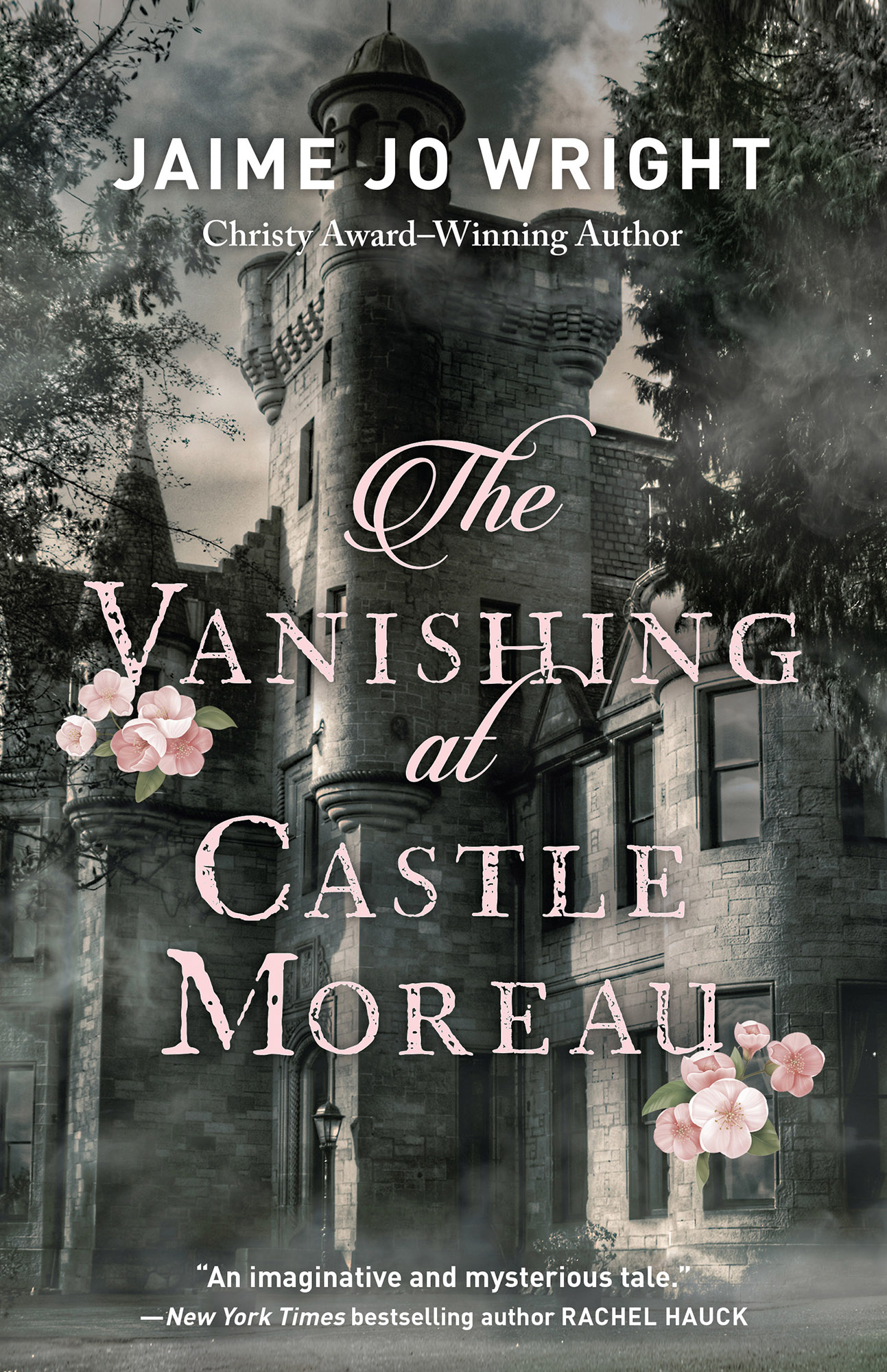
In 1801 a young girl living in Castle Moreau is visited by a female phantom, a terrifying creature with a misshapen hand. A vision her father says is a dream, but she knows to be real. In 1870 Daisy François begins work as a housekeeper at Castle Moreau, despite tales that women disappear from the area and the fact that the mistress of the castle writes frightening Gothic stories. In the present day Cleo Clemmons is running away from her life. Living off grid she takes a job at Castle Moreau, hired by the grandson of the elderly owner to help organize it. Cleo soon realizes the job may be more than she can handle. Will Castle Moreau keep its secrets or will a woman who wants to disappear reveal them once and for all?
Vulnerable women, hauntings, fear, possible madness, and, dare I say a hint of forbidden romance make THE VANISHING AT CASTLE MOREAU a chilling Gothic novel. The three stories from three time periods propel each other, as each one layers on an aspect of haunting, drawing the reader in just as Castle Moreau draws in women. Compelling and enthralling, the facts are hidden until the end.
Playing on the fears many of us have, I was entranced, wondering what exactly to believe in the first two time periods. In the present day portion I was beyond curious what exactly happened to make Cleo run. Indeed, it was the many thoughts the book provoked that had me as entranced as the actual words written. All of the characters are intriguing, my favorites being Daisy and Deacon, with the most fascinating being Castle Moreau itself.
Full of atmospheric suspense THE VANISHING AT CASTLE MOREAU is a delightfully spooky novel incorporating themes of loss, faith, and redemption.
In 1870, orphaned Daisy François takes a position as housemaid at a Wisconsin castle to escape the horrors of her past life. There she finds a reclusive and eccentric Gothic authoress, who hides tales more harrowing than the ones in her novels. With women disappearing from the area and a legend that seems to parallel these eerie circumstances, Daisy is thrust into a web that threatens to steal her sanity, if not her life.
In the present day, Cleo Clemmons is hired by the grandson of an American aristocratic family to help his grandmother face her hoarding in the dilapidated Castle Moreau. But when Cleo uncovers more than just the woman's stash of collectibles, a century-old mystery of disappearance, insanity, and the dust of the old castle's curse threaten to rise again. This time to leave no one alive to tell the sordid tale.
Award-winning author Jaime Jo Wright seamlessly weaves a dual-time tale of two women who must do all they can to seek the light amidst the darkness shrouding Castle Moreau.
"With real, flawed characters, who grapple with real-life struggles, readers will be drawn into this gripping suspense from the very first page. Good luck putting it down. I couldn't."
"Wright pens another delightfully creepy tale where nothing is quite as it seems and characters seek freedom from nightmares both real and imagined."
"Wright captivates. A thrilling tale. . . . Readers won’t want to put this down."
The one who rescues,
who loves,
and who stands in the gap.
God knew I needed you.
The Girl
MAY 8, 1801
When I was a little girl, my father would often come to my bedside after my screams wakened him in the night. He would smooth back my damp ringlets, the mere feel of his callused and strong hand inspiring an instantaneous calm.
“What is it, little one?” he would ask me.
Every night, the same question. Every night, I would give the same answer.
“It is her again, Papa.”
“Her?” He would tilt his head, giving credence to my words and refraining from scolding or mockery.
“Yes.” I would nod, my head brushing the clean cotton of my pillowcase. “The woman with the crooked hand.”
“Crooked hand, hmm?” His query only increased my adamant insistence.
“Yes. She has a nub with two fingers.” A tear would often trail down my six-year-old cheek.
My father would smile with a soothing calm. “You are dreaming again, mon chéri.”
“No. She was here.” He must believe me!
“Shhh.” Another gentle stroke of his hand across my forehead. “She is the voice of the mistress of your dreams. We all have one, you know. Only yours needs extra-special care because she isn’t beautiful like the rest. She is the one who brings the nightmares, but she doesn’t mean to harm you. She is only doing her best with what she has been given, and what she has been given are her own horrors.”
“Her hand?” I would reply, even though we repeated this explanation many nights in a row.
“Yes,” my father would nod. “Her hand is a reflection of the ugliness in her stories. Stories she tells to you at night when all is quiet and your eyes are closed.”
“But they were open,” I would insist.
“No. You only think they were open.”
“I am afraid of the ghost, Papa,” I urge.
His eyes smile. “Oui. And yet there are no spirits to haunt you. Only the dream mistress. Shoo her away and she will flee. She is a mist. She is not real. See?” And he would wave his hand in the air. “Shoo, mistress. Away and be gone!”
We would survey the dark bedroom then, and, seeing nothing, my father would lean over and press his lips to my cheek. “Now sleep. I will send your mother’s dream mistress to you. Her imaginings are pleasant ones.”
“Thank you,” I would whisper.
Another kiss. The bed would rise a bit as he lifted his weight from the mattress. His nightshirt would hang around his shins, and he would pause at the doorway of my room where I slept. An only child, in a home filled with the fineries of a Frenchman’s success of trade. “Sleep, mon chéri.”
“Yes, Papa.”
The door would close.
My eyes would stay open.
I would stare at the woman with the crooked hand, who hovered in the shadows where the door had just closed. I would stare at her and know what my father never would.
She existed.
She was not a dream.
one
Daisy François
APRIL 1870
The castle cast its hypnotic pull over any passerby who happened along to find it, tucked deep in the woods in a place where no one would build a castle, let alone live in one. It served no purpose there. No strategy of war, no boast of wealth, no respite for a tired soul. Instead, it simply existed. Tugging. Coercing. Entrapping. Its two turrets mimicked bookends, and if removed, one would fear the entire castle would collapse like a row of standing volumes. Windows covered the façade above a stone archway, which drew her eyes to the heavy wooden door with its iron hinges, the bushes along the foundation, and the stone steps leading to the mouth of the edifice. Beyond it was a small orchard of apple trees, their tiny pink blossoms serving as a delicate backdrop for the magnificent property.
Castle Moreau.
Home to an orphan. Or it would be.
Daisy clutched the handles of her carpetbag until her knuckles were sure to be white beneath her threadbare gloves. She stood in the castle’s shadow, staring at its immense size. Who had built such an imposing thing? Here, in the northern territory, where America boasted its own mansions but still rejected any mimicking of the old country. Castles were supposed to stare over their fiefdoms, house lords and ladies, gentry, noblemen, and summon the days of yore when knights rescued fair maidens. Castles were not supposed to center themselves inside a forest, on the shore of a lake, a mile from the nearest town.
This made Castle Moreau a mystery. No one knew why Tobias Moreau had built it decades before. Today the castle held but one occupant: Tobias’s daughter, Ora Moreau, who was eighty-six years old. She was rarely ever seen, and even more rarely, ever heard from. Still, Ora’s words had graced most households in the region, printed between the covers of books with embossed golden titles. Her horror stories had thrilled many readers, and over the years, the books helped in making an enigma of the reclusive old woman.
When the newspaper had advertised a need for a housemaid—preferably one without a home or ties to distract her from her duties—it was sheer coincidence that Daisy had seen it, even more of a coincidence that she fit the requirements. And so it was a surprise she was hired after only a brief letter inquiring after the position.
Now she stood before the castle, her pulse thrumming with the question why? Why had she accepted the position? Why would she allow herself to be swallowed up by this castle? The stories were bold, active. Women disappeared here. It was said that Castle Moreau was a place that consumed the vulnerable. Welcoming them in but never giving them back.
Daisy stiffened her shoulders. Swallowed. Tilted her chin upward in determination. She had marched into hell before—many times, in fact. Castle Moreau couldn’t possibly be much worse than that.
Cleo Clemmons
TWO YEARS BEFORE PRESENT DAY
They had buried most souvenirs of the dead with the traditions of old, and yet what a person didn’t understand before death, they would certainly comprehend after. The need for that ribbon-tied lock of hair, the memento mori photograph of the deceased, a bone fragment, a capsule of the loved one’s ashes—morbid to those who had not lost, but understandable to those who had.
Needing to touch the tangible was a fatal flaw in humanity. Faith comforted only so far until the gasping panic overcame the grieving like a tsunami, stealing oxygen, with the only cure being something tangible. Something to touch. To hold. To be held. It was in these times the symbolism attached to an item became pivotal to the grieving. A lifeline of sorts.
For Cleo, it was a thumbprint. Her grandfather’s thumbprint. Inked after death, digitized into a .png file, uploaded to a jewelry maker, and etched into sterling silver. It hung around her neck, settling between her breasts, just left of her heart. No one would know it was there, and if they did, they wouldn’t ask. A person didn’t ask about what was held closest to another’s heart. That was information that must be offered, and Cleo had no intention of doing so. To anyone. Her grandfather was her memory alone—the good and the bad. What he’d left behind in the form of Cleo’s broken insides were Cleo’s to disguise. Faith held her hand, or rather, she clenched hands with faith, but in the darkness, when no one was watching, Cleo fit her thumb to her grandfather’s print and attempted to feel the actual warmth of his hand, to infuse all the cracks and offer momentary refuge from the ache.
Funny how this was what she thought of. Now. With what was left of her world crashing down around her like shrapnel pieces, blazing lava-orange and deadly.
“Pick up, pick up, pick up,” Cleo muttered into her phone, pressing it harder against her ear than she needed to. She huddled in the driver’s seat of her small car, all of her worldly possessions packed into the trunk and the back seat. She could hear the ringing on the other end. She owed it to Riley. One call. One last goodbye.
“Hey.”
“Riley!” Cleo stiffened in anticipation.
“. . . you’ve reached Riley . . .” the voice message continued, and Cleo laid her head back against the seat. The recording finished, and Cleo squeezed her eyes shut against the world outside of her car, against the darkness, the fear, the grief. This was goodbye. It had to be.
The voicemail beep was Cleo’s cue. She swallowed, then spoke, her words shivering with compressed emotion. What did a person say in a last farewell?
“Riley, it’s me. Cleo. I—” she bit her lip, tasting blood—“I-I won’t be calling again. This is it. You know. It’s what I hoped would never happen. I am so, so sorry this happened to you! Just know I tried to protect you. But now—” her breath caught as tears clogged her throat—“this is the only way I can. Whatever happens now, just know I love you. I will always love you.” Desperation warred with practicality.
Shut off the phone.
There was no explaining this.
There never would be.
“Goodbye, Ladybug.” Cleo thumbed the end button, then threw the phone against the car’s dashboard. A guttural scream curled up her throat and split her ears as the inside of the vehicle absorbed the sound.
Then it was silent.
That dreadful, agonizing silence that came with the burgeoning, unknown abyss of a new start. Cleo stared at her phone lying on the passenger-side floor. She lunged for it, fumbling with a tiny tool until she popped open the slot on its side. Pulling out the SIM card, Cleo bent it back and forth until it snapped. Determined, she pushed open the car door and stepped out.
The road was heavily wooded on both sides. Nature was her only observer.
She flung the broken SIM card into the ditch, marched to the front of the car, and wedged the phone under the front tire. She’d roll over it when she left, crush it, and leave nothing to be traced.
Cleo took a moment to look around her. Oak forest, heavy undergrowth of brush, wild rosebushes whose thorns would take your skin off, and a heap of dead trees and branches from the tornado that had ravaged these woods decades prior. The rotting wood was all that remained to tell the tale now, but it was so like her life. Rotting pieces that never went away. Ever.
She climbed back into the car and twisted the key, revving the engine to life. Cleo felt her grandfather’s thumbprint until it turned her skin hot with the memories. Memories of what had set into motion a series of frightful events. Events that were her responsibility to protect her sister from.
Goodbye, Ladybug.
There was no explaining in a voicemail to a twelve-year-old girl that her older sister was abandoning her in order to save her. Cleo knew from this moment on, Riley would play that message, and slowly resentment would seep in as she grew older. Resentment that Cleo had left and would never come back.
But she couldn’t go back. Not if she loved Riley. Sometimes love required the ultimate sacrifice. Sometimes love required death. Death to all they knew, all they had known. If Cleo disappeared, then Riley would be left alone. Riley would be safe. She could grow up as innocent as possible.
So long as Cleo Clemmons no longer existed.
***
Excerpt from The Vanishing at Castle Moreau by JAIME JO WRIGHT. Copyright 2023 by Jaime Sundsmo. Reproduced with permission from Bethany House Publishers. All rights reserved. No part of this publication may be reproduced, stored in a retrieval system, or transmitted in any form or by any means—for example, electronic, photocopy, recording—without the prior written permission of the publisher. The only exception is brief quotations in printed reviews.
Visit these other great hosts on this tour for more great reviews, interviews, guest posts, and giveaway entries!