Showing posts with label Gilded Age. Show all posts

Friday, May 22, 2026

The Last Fatal Hour - A Review, Excerpt, & Giveaway

Review


THE LAST FATAL HOUR
By Jan Matthews

Leona Gladney has secrets. She was a soldier in the Civil War and is currently an author trying to please a new husband and Brooklyn society. When her husband's business partner absconds with their money life gets more difficult. Dealing with her mercurial husband, Leona is also distraught when her good friend Daphne dies and she's accused of stealing her jewelry. Could Daphne's grandson be behind her death? What about those Spiritualists? Leona is determined to clear her name, but is someone just as determined to see her suffer?

Filled with interesting historical detail and unusual characters THE LAST FATAL HOUR captured and held my attention. An adventurous tomboy, Leona is almost too caring. Indeed, her willingness to help others nearly gets her killed. I love her relationship with her grandfather. Along with Mrs. McCarthy and Ruth he is one of my favorite characters. Rich characterizations, a household simmering with stress, and more than one mystery had me quickly turning the pages.

While it didn't exist as a term at the time, some civil war soldiers did suffer from what's now known as post traumatic stress disorder and we see this with Leona's nightmares and flashbacks. It's even more of a challenge as she is unable to share her story freely, not even to the man who's supposed to protect her, her husband. This is also a time when a man who wants to rid himself of a wife can easily have her committed to a "lunatic asylum". A dangerous time to be a woman, and an especially dangerous one for Leona.  

A compelling historical mystery THE LAST FATAL HOUR will leave you shocked, angered, and ultimately satisfied.

************************************************************************** 
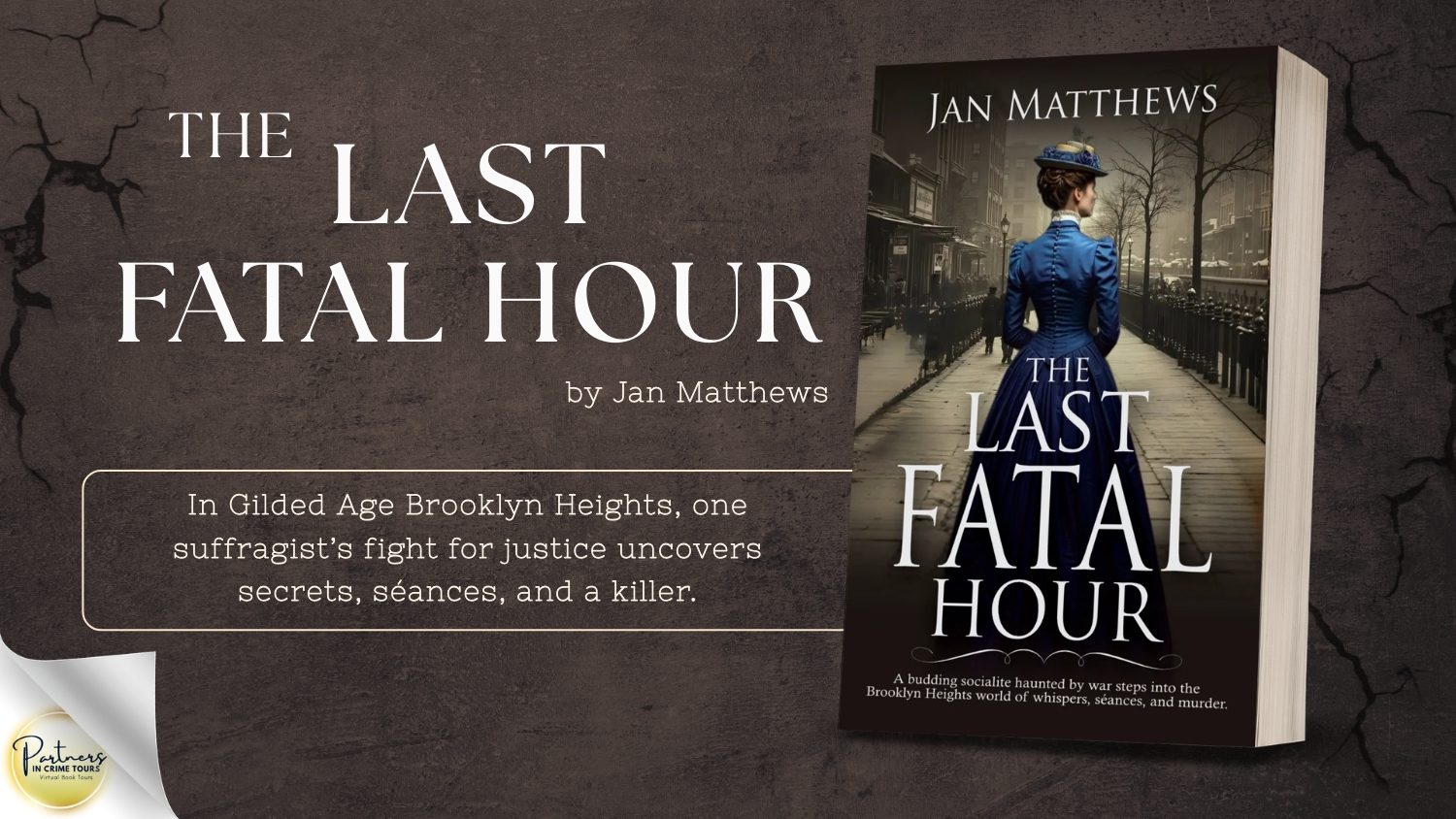
THE LAST FATAL HOUR by Jan Matthews Banner

THE LAST FATAL HOUR

by Jan Matthews

May 4 - 29, 2026 Virtual Book Tour

Synopsis:
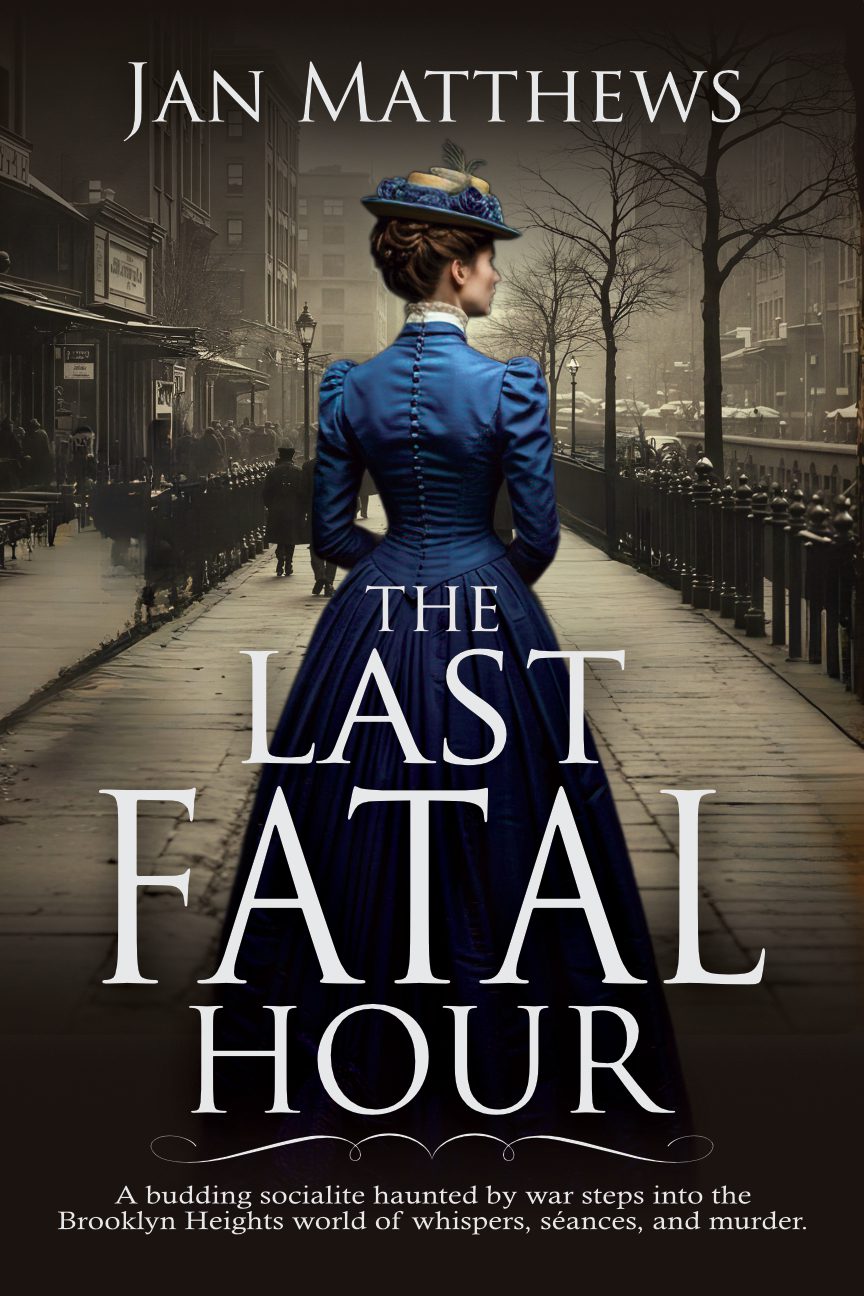
The Last Fatal Hour by Jan Matthews

For Leona Gladney, former woman soldier of the Union Army, life goes on despite the echoes of the battlefield in her heart. Now a suffragist and budding socialite in Brooklyn Heights, she yearns for a literary life and family. But her husband’s business partner embezzles their money and disappears.

The society matrons of Brooklyn Heights turn a gimlet eye on Leona after the suspicious death of a wealthy friend. Leona will do anything to find justice for her friend and clear her own name, but she finds only secrets, seances and murder.

Book Details:

Genre: Historical Mystery
Published by: Coffee&ink Press
Publication Date: April 7, 2026
Number of Pages: 320
ISBN: 9798232470982
Book Links: Amazon | Barnes & Noble | BookShop.org | Goodreads

Read an excerpt:

CHAPTER ONE

The blot of ink stuck to her finger, tacky like drying blood. Leona scrubbed at it with her handkerchief as the clock chimed two hours after midnight. She capped the inkwell, and while the ink dried on her most recent entry, she organized the copies with ribbons. Blue for Daphne and red for Ruth. With shaking hands, she slipped the copies into stiff cardboard folios and tied them closed. Sighing, she set them on the desk in front of her.

The flames in the hearth beckoned. This wasn’t the first night she’d yearned for obliteration. It wouldn’t come if she gave in to the urge to throw her labor into the fire. Only paper and ink would vanish, leaving the memories behind.

Pen and ink or back to the laudanum.

A grim thought, the grimmest of all.

The words had clawed their way out tonight. She’d begun the memoir of her time as a Union soldier months ago with the hope her drowning spirits would revive once the words dropped to the page. Yet the foreboding crept through her and tightened around her throat as the little study filled with familiar shadows. This old terror had become a second skin, like the tattered and dirty uniform she’d once worn.

Over the monotonous chatter of the rain, the clock ticked away the seconds until her husband came home. Leona moved to the window, pushed aside the heavy velvet curtains, and looked out at night-shrouded Cranberry Street. A lamp glowed in a window across the street. Homesickness for Boston, for life before the war, for herself before the war, settled on her. The wind threw a heavy splash of rain against the window, and she jumped back, letting go of the curtain.

Pacing the study, her restless thoughts rushed on without fatigue. To keep the memories inside only fed the persistent mental return to the battlefield, and the outpouring of words somewhat tamed her tormented soul. She stopped and touched the folio. Work would save her: work, family, friendship, and love. Maybe she’d write a story about two clocks. A natural clock which kept good time and a mad clock that twisted time out of true.

The street door below opened and closed. At last Gil, home safe. She couldn’t even bring herself to scold him for being so late. Leona listened for his footsteps as she crossed the room to tuck the folios into her desk drawer and locked it. She closed the gaslight apertures in the study and turned up the flame on the wall sconces in the drafty hallway so he could find his way. In the bedroom, she shed her dressing gown, stepped out of her slippers, and kicked them under the bed. Gil made his clumsy climb up the stairs. When he stumbled into the room, she pulled the covers back. He fell into bed fully clothed beside her, mumbling and fretful, the sharp ripe scent of whiskey lacing his breath.

She laid her hand on his shoulder. Beneath the cloth of his shirt, his skin was cold and damp. “Rest now, go to sleep,” she whispered.

***

At first light, Leona had dressed in a blue and cream day gown and made her way downstairs for breakfast. The creeping dread of the night before had waned. She rubbed her gritty eyes and yawned again. Mrs. McCarthy poured coffee from the silver pot, the familiar, civilized table a welcome sight. The scent of bacon made her stomach growl.

“Are you well, m’um?”

Leona glanced into the broad face of their cook and housekeeper, a sturdy and mature woman with a comforting Irish burr. She wore her fading blonde hair in a crown around her head.

“I didn’t sleep much.” Leona yawned again behind her fingers.

Gil’s heavy tread on the stairs made them both jump, and Mrs. McCarthy squeaked.

“I’ll bring more breakfast in a jiffy.” She fled through the side door to the kitchen just as Gil ducked through the hall entrance.

Leona rose and smiled at her husband. He’d made a great effort to come down early after returning so late. She accepted his peck on the cheek, poured him coffee and set it between them, wifely mask in place. He glared with bloodshot eyes at the letter in his hand, and her stomach clenched.

“It’s not all bad news, Gil.” She’d read the contents of the letter before leaving it on his desk in his study, as Grandfather had addressed it to both.

He raised his hazel eyes to her. “You recall Henry has absconded with all our funds?” he asked in a sarcastic tone, squinting at the letter, then back at her.

She no longer knew what to say about Gil’s former business partner, Henry Caldwell-Jones. The police were still looking for him. It put the devil in Gil’s eyes to speak of it, so she tried to let it be, not wanting to distress him even more.

“Of course, I remember, Gil. I—”

“And now your grandfather won’t give me a second loan. I’ll have to go back to the bank and ask them again.”

“He only wants to speak with you face to face about our situation,” she said, in her grandfather’s defense. “He’ll help us, Gil. He did offer to speak at the lyceum on his return from Ohio, to help raise funds. It isn’t as if—” Or was it? “We won’t lose the house, will we?”

The muscles in his lean face twitched as Gil fought to hide his disappointment, and her heart broke a little more to witness it. “Your grandfather does not bring in the interest he once did.”

It was true Leona’s grandfather, poet, abolitionist, and Transcendentalist, didn’t bring in the money he used to at readings in New York and Brooklyn, but he didn’t suffer for it.

Gil raked his fingers through his thick, brown hair and opened his mouth. Mrs. McCarthy entered with his breakfast, apparently stopping what he meant to say next. He reached inside the pocket of his trousers and pulled out a small notebook and pencil. Laying them on the table, his frown deepened.

Once Mrs. McCarthy had bustled out again, Leona said, “I could write to Aunt Louisa.” Who was not truly an aunt, but a friend of her mother’s.

He opened the notebook and touched the tip of his tongue to the pencil. “We cannot afford to feed and house a man of Bronson Alcott’s caliber,” he replied with heaviness. He bent his head to the columns of numbers on the pages.

His confidence and spirits were usually high, and it hurt to see him laid so low. She did mean Louisa Alcott herself, not her father Bronson Alcott, as the speaker for the lyceum to draw a crowd. Her novel, Little Women, published two years before, had become hugely popular.

“I’ll sell the lyceum, that should help,” Gil murmured, eyes downcast.

Leona winced. It was where they’d met nearly a year before. At a loss again, she glanced down at her lapel watch—9 o’clock already. She stood and set cups and plates on the tray.

“Let Mrs. McCarthy do that.” His pencil went on calculating their precarious position.

“I don’t mind. I’m off to see Daphne this morning. I won’t be home until the late afternoon.” Taking a deep breath, she dared to ask, not expecting an answer. “How much do we owe?” She blew out her held breath, apprehension biting at her. “Why won’t you tell me how much Henry has stolen?”

“He’s made me a laughingstock.” His handsome lips formed a tight smile, but he didn’t look at her. “Don’t you worry, Leona, leave it to me. This will all be over by Christmas.”

***

On the street, she began to walk, then turned to observe the window where Gil labored, smoke curling from the chimney. The image stayed with her as she made her way to the newsstand around the corner and waited patiently for her turn to buy a paper. The sunny day, though cold, had driven people outdoors, well wrapped in fur-collared coats and wool scarves. Woodsmoke and the sharp tang of the river mingling with the scent of baking bread drifted on the breeze. She chewed on the frustration that he wouldn’t share their financial details with her. It made her more fearful not to know. Though she kept the memoir and chapter stories a secret from him, this was hardly the same.

Passing the newsstand, an article about the new bridge caught her eye so she bought the latest Brooklyn Eagle. The previous summer, the four of them, Henry, his wife Helen, herself, and Gil, had stood at the end of Noble Street to watch the construction of the giant caissons in the naval yard. Though approval of the bridge was a long-foregone conclusion, the article was typical of the Eagle’s awful anti-consolidation fear mongering. The article repeated the claim linking the boroughs would only bring the dregs of Manhattan’s Lower East Side into Brooklyn’s pure white Heights. The wrongness of such an attitude churned her stomach.

Leona folded the paper and tucked it under her arm with the folio, sighing. Who would save the poor of this world from the hatred of the rich? Her spirits drooped lower.

She breathed deep the November air on familiar, tree-lined Remsen Street, where she’d lived for two years before marrying Gil in August. The red door of the brownstone opened, welcoming her in. Timothy, the butler, took her hat and coat. Before he disappeared with them, his eyes met hers with a familiar blue twinkle.

“I’ll tell her you’re here,” he said.

“Thank you.” She inhaled the sweet smell of hothouse roses set in vases along the long hallway and waited for word of her arrival to reach Daphne and her nurse Audrey.

Audrey approached from the depths of the house. Her eyes, though hooded, were a pure delphinium blue, blonde hair pinned tight to her head. She wore a plain uniform of dark gray with long cuffed sleeves and a white apron.

“Mrs. Van Wyn is in the Lavender Room.” With a curt nod, she turned away.

When they first met, Leona and Audrey had often shared tea and conversation, but of late Leona felt nothing but a wall of smothered animosity between them. They hadn’t argued, as such, though she had an idea where the strained relations came from.

“Is she well?” Leona asked.

For a moment, she didn’t think Audrey would answer, but the woman turned toward her again. “She passed a quiet night. The laudanum helps.”

Leona frowned. Audrey flicked a dismissive hand and went on her way.

The introduction of laudanum in Daphne’s life began not long after Leona moved to Cranberry Street with Gil that summer. The spas and cures Daphne’s grandson Benedict and his wife arranged didn’t seem to help anymore. The family hired Audrey, who administered the laudanum, a common enough panacea. Laudanum’s presence always disturbed Leona, and she had protested to the family, but no one listened. Audrey had become cold after this discussion. Leona believed some of Daphne’s pain came from her daily battle with grief. Leona often feared her own grief and the overuse of laudanum, prescribed by a respected doctor in Boston, had killed the child from her previous marriage to Jack Davenport. Poor dead Jack.

***

Excerpt from The Last Fatal Hour by Jan Matthews. Copyright 2026 by Jan Matthews. Reproduced with permission from Jan Matthews. All rights reserved.


Author Bio:

Jan Matthews

Jan Matthews is an American expat living in the sunshine in Portugal.

She is (finally) retired from HIM and writes historical mysteries from the Middle Ages to World War I. When not writing or drinking coffee and wine in nearby cafes, she knits and crochets for charity and reviews books on her blog.

Catch Up With Jan Matthews:

coffeeandinkbooks.wordpress.com
Amazon Author Profile
Goodreads - @coffeeink
BookBub - @coffeeandink1
Instagram - @coffeeandink197
X - @coffeeandink2
BlueSky - @coffeeandink2.bsky.social


Tour Participants:

Click through the other tour stops for can’t-miss reviews, insider interviews, exclusive guest posts, and more chances to win!

Click here to view the Tour Schedule


Enter Before THE LAST FATAL HOUR Strikes...

This giveaway is hosted by Partners in Crime Tours for Jan Matthews. See the widget for entry terms and conditions. Void where prohibited.
THE LAST FATAL HOUR by Jan Matthews || Gift Cards

Can't see the giveaway? Click Here!
Get More Great Reads at Partners In Crime Tours

Wednesday, May 20, 2026

Currently Reading...

I'm currently reading The Last Fatal Hour by Jan Matthews. 

Leona Gladney has secrets. She was a soldier in the Civil War and is currently an author trying to please a new husband and Brooklyn society. When her husband's business partner absconds with their money life gets more difficult. Dealing with her mercurial husband, Leona is also distraught when her good friend Daphne dies and she's accused of stealing her jewelry. Could Daphne's grandson be behind her death? What about those Spiritualists? Leona is determined to clear her name, but is someone just as determined to see her suffer?

Tuesday, May 19, 2026

The Last Fatal Hour - An Interview, Excerpt, & Giveaway

I'm pleased to welcome Jan Matthews to Cozy Up With Kathy today. Jan's most recent release is THE LAST FATAL HOUR.


Kathy: In THE LAST FATAL HOUR we meet Leona Gladney, a former woman soldier of the Union Army. What made you choose to give your protagonist this unique background?

JM: I really wanted a woman sleuth who would stand out in a popular though crowded genre. When I started reading about women soldiers during the American Civil War, I knew this would be Leona’s background. I find the aftermath of trauma rich material for story.

Kathy: Leona finds secrets, seances and murder. Spiritualism as a religion began in the mid 1800s in Western New York and was flourishing by the end of the century. It was not uncommon for fashionable members of society to host seances and seek guidance from the spirit world. Have you ever been to a seance?

JM: We held “seances” with a ouija board in college. I think that might be another story, lol. I also visited a medium shortly after my first husband died, with weirdly mixed results. But I’ve always found Spiritualism, abolition, and suffrage linked. One of the wonderful podcast series by Aaran Mahnke, Unobscured, devotes a season to Spiritualists and Mediums. Also Shelby Scott’s podcast Mediums is a fascinating look at the contrast between the way society treated male mediums versus female. 
 

Kathy: Historical mysteries require an extra special brand of research. What's your favorite method to research this time period?

JM: Books, books, books. I’ve also visited a number of Civil War battlefields and follow a few Civil War related Facebook pages, mostly because they post photographs. How many times can I watch Gods And Generals or Glory? A lot. I also listen to the music of the time via YouTube.

Kathy: What first drew you to historical mysteries?

JM: I’ve always read eclectically. I loved fantasy for a long, long time, but in the 90s I gave up on it. I thought I would be a fantasy writer, and so read a lot of European history, as one does, to help me with world building. I became more interested in the real history more than the made-up ones I was reading. Does that make sense? I’d always loved Cadfael and Dame Frevrisse and just started reading historical mysteries wherever and whenever the spirit moved me.

Kathy: Do you write in any other genres?

JM: I published Gay Romance under the pseudonym Heloise West, but I’m not interested in writing Romance anymore. Well, never say never. I wrote for a few small presses and most of them folded, so I have the rights back to four novels and one novella.

Kathy: What are you currently reading?

JM: I review on my blog for NetGalley and BookSirens, so those books are usually at the top of the TBR. So THE SMALL HOURS by Edward Averett for BookSirens and THE SEA CHILD by Linda Wilgus for myself. I’m ahead of my NetGalley list so I dipped into the TBR pile instead.


Kathy: Name 4 items you always have in your fridge or pantry.

JM: Cheese, wine, eggs, and bread.

Kathy: Do you have plans for future books?

JM: Next up is a murder mystery set in the artists’ workshops of Renaissance Florence. I’m tentatively working on a sequel to THE LAST FATAL HOUR and a mystery with a woman magician in the early 20th century as sleuth. If those could be completed and all published by 2027, I would be very happy. I have an idea for a medieval mystery series and a voice telling me her story, so that will likely be next. I work on stories usually two at a time until one dominates as far as process is concerned. It’s never the same way twice.
 

Kathy: What's your favorite thing about being an author?

JM: Process. It’s the journey not the destination. Publishing is fun, but then we’re faced with marketing and plugging the book instead of working on the next one, but oh well. This is part of the process I also enjoy, talking about the story and the characters and reading reviews (only the good ones, haha!) 

************************************************************************

THE LAST FATAL HOUR by Jan Matthews Banner

THE LAST FATAL HOUR

by Jan Matthews

May 4 - 29, 2026 Virtual Book Tour

Synopsis:

The Last Fatal Hour by Jan Matthews

For Leona Gladney, former woman soldier of the Union Army, life goes on despite the echoes of the battlefield in her heart. Now a suffragist and budding socialite in Brooklyn Heights, she yearns for a literary life and family. But her husband’s business partner embezzles their money and disappears.

The society matrons of Brooklyn Heights turn a gimlet eye on Leona after the suspicious death of a wealthy friend. Leona will do anything to find justice for her friend and clear her own name, but she finds only secrets, seances and murder.

Book Details:

Genre: Historical Mystery
Published by: Coffee&ink Press
Publication Date: April 7, 2026
Number of Pages: 320
ISBN: 9798232470982
Book Links: Amazon | Barnes & Noble | BookShop.org | Goodreads

Read an excerpt:

CHAPTER ONE

The blot of ink stuck to her finger, tacky like drying blood. Leona scrubbed at it with her handkerchief as the clock chimed two hours after midnight. She capped the inkwell, and while the ink dried on her most recent entry, she organized the copies with ribbons. Blue for Daphne and red for Ruth. With shaking hands, she slipped the copies into stiff cardboard folios and tied them closed. Sighing, she set them on the desk in front of her.

The flames in the hearth beckoned. This wasn’t the first night she’d yearned for obliteration. It wouldn’t come if she gave in to the urge to throw her labor into the fire. Only paper and ink would vanish, leaving the memories behind.

Pen and ink or back to the laudanum.

A grim thought, the grimmest of all.

The words had clawed their way out tonight. She’d begun the memoir of her time as a Union soldier months ago with the hope her drowning spirits would revive once the words dropped to the page. Yet the foreboding crept through her and tightened around her throat as the little study filled with familiar shadows. This old terror had become a second skin, like the tattered and dirty uniform she’d once worn.

Over the monotonous chatter of the rain, the clock ticked away the seconds until her husband came home. Leona moved to the window, pushed aside the heavy velvet curtains, and looked out at night-shrouded Cranberry Street. A lamp glowed in a window across the street. Homesickness for Boston, for life before the war, for herself before the war, settled on her. The wind threw a heavy splash of rain against the window, and she jumped back, letting go of the curtain.

Pacing the study, her restless thoughts rushed on without fatigue. To keep the memories inside only fed the persistent mental return to the battlefield, and the outpouring of words somewhat tamed her tormented soul. She stopped and touched the folio. Work would save her: work, family, friendship, and love. Maybe she’d write a story about two clocks. A natural clock which kept good time and a mad clock that twisted time out of true.

The street door below opened and closed. At last Gil, home safe. She couldn’t even bring herself to scold him for being so late. Leona listened for his footsteps as she crossed the room to tuck the folios into her desk drawer and locked it. She closed the gaslight apertures in the study and turned up the flame on the wall sconces in the drafty hallway so he could find his way. In the bedroom, she shed her dressing gown, stepped out of her slippers, and kicked them under the bed. Gil made his clumsy climb up the stairs. When he stumbled into the room, she pulled the covers back. He fell into bed fully clothed beside her, mumbling and fretful, the sharp ripe scent of whiskey lacing his breath.

She laid her hand on his shoulder. Beneath the cloth of his shirt, his skin was cold and damp. “Rest now, go to sleep,” she whispered.

***

At first light, Leona had dressed in a blue and cream day gown and made her way downstairs for breakfast. The creeping dread of the night before had waned. She rubbed her gritty eyes and yawned again. Mrs. McCarthy poured coffee from the silver pot, the familiar, civilized table a welcome sight. The scent of bacon made her stomach growl.

“Are you well, m’um?”

Leona glanced into the broad face of their cook and housekeeper, a sturdy and mature woman with a comforting Irish burr. She wore her fading blonde hair in a crown around her head.

“I didn’t sleep much.” Leona yawned again behind her fingers.

Gil’s heavy tread on the stairs made them both jump, and Mrs. McCarthy squeaked.

“I’ll bring more breakfast in a jiffy.” She fled through the side door to the kitchen just as Gil ducked through the hall entrance.

Leona rose and smiled at her husband. He’d made a great effort to come down early after returning so late. She accepted his peck on the cheek, poured him coffee and set it between them, wifely mask in place. He glared with bloodshot eyes at the letter in his hand, and her stomach clenched.

“It’s not all bad news, Gil.” She’d read the contents of the letter before leaving it on his desk in his study, as Grandfather had addressed it to both.

He raised his hazel eyes to her. “You recall Henry has absconded with all our funds?” he asked in a sarcastic tone, squinting at the letter, then back at her.

She no longer knew what to say about Gil’s former business partner, Henry Caldwell-Jones. The police were still looking for him. It put the devil in Gil’s eyes to speak of it, so she tried to let it be, not wanting to distress him even more.

“Of course, I remember, Gil. I—”

“And now your grandfather won’t give me a second loan. I’ll have to go back to the bank and ask them again.”

“He only wants to speak with you face to face about our situation,” she said, in her grandfather’s defense. “He’ll help us, Gil. He did offer to speak at the lyceum on his return from Ohio, to help raise funds. It isn’t as if—” Or was it? “We won’t lose the house, will we?”

The muscles in his lean face twitched as Gil fought to hide his disappointment, and her heart broke a little more to witness it. “Your grandfather does not bring in the interest he once did.”

It was true Leona’s grandfather, poet, abolitionist, and Transcendentalist, didn’t bring in the money he used to at readings in New York and Brooklyn, but he didn’t suffer for it.

Gil raked his fingers through his thick, brown hair and opened his mouth. Mrs. McCarthy entered with his breakfast, apparently stopping what he meant to say next. He reached inside the pocket of his trousers and pulled out a small notebook and pencil. Laying them on the table, his frown deepened.

Once Mrs. McCarthy had bustled out again, Leona said, “I could write to Aunt Louisa.” Who was not truly an aunt, but a friend of her mother’s.

He opened the notebook and touched the tip of his tongue to the pencil. “We cannot afford to feed and house a man of Bronson Alcott’s caliber,” he replied with heaviness. He bent his head to the columns of numbers on the pages.

His confidence and spirits were usually high, and it hurt to see him laid so low. She did mean Louisa Alcott herself, not her father Bronson Alcott, as the speaker for the lyceum to draw a crowd. Her novel, Little Women, published two years before, had become hugely popular.

“I’ll sell the lyceum, that should help,” Gil murmured, eyes downcast.

Leona winced. It was where they’d met nearly a year before. At a loss again, she glanced down at her lapel watch—9 o’clock already. She stood and set cups and plates on the tray.

“Let Mrs. McCarthy do that.” His pencil went on calculating their precarious position.

“I don’t mind. I’m off to see Daphne this morning. I won’t be home until the late afternoon.” Taking a deep breath, she dared to ask, not expecting an answer. “How much do we owe?” She blew out her held breath, apprehension biting at her. “Why won’t you tell me how much Henry has stolen?”

“He’s made me a laughingstock.” His handsome lips formed a tight smile, but he didn’t look at her. “Don’t you worry, Leona, leave it to me. This will all be over by Christmas.”

***

On the street, she began to walk, then turned to observe the window where Gil labored, smoke curling from the chimney. The image stayed with her as she made her way to the newsstand around the corner and waited patiently for her turn to buy a paper. The sunny day, though cold, had driven people outdoors, well wrapped in fur-collared coats and wool scarves. Woodsmoke and the sharp tang of the river mingling with the scent of baking bread drifted on the breeze. She chewed on the frustration that he wouldn’t share their financial details with her. It made her more fearful not to know. Though she kept the memoir and chapter stories a secret from him, this was hardly the same.

Passing the newsstand, an article about the new bridge caught her eye so she bought the latest Brooklyn Eagle. The previous summer, the four of them, Henry, his wife Helen, herself, and Gil, had stood at the end of Noble Street to watch the construction of the giant caissons in the naval yard. Though approval of the bridge was a long-foregone conclusion, the article was typical of the Eagle’s awful anti-consolidation fear mongering. The article repeated the claim linking the boroughs would only bring the dregs of Manhattan’s Lower East Side into Brooklyn’s pure white Heights. The wrongness of such an attitude churned her stomach.

Leona folded the paper and tucked it under her arm with the folio, sighing. Who would save the poor of this world from the hatred of the rich? Her spirits drooped lower.

She breathed deep the November air on familiar, tree-lined Remsen Street, where she’d lived for two years before marrying Gil in August. The red door of the brownstone opened, welcoming her in. Timothy, the butler, took her hat and coat. Before he disappeared with them, his eyes met hers with a familiar blue twinkle.

“I’ll tell her you’re here,” he said.

“Thank you.” She inhaled the sweet smell of hothouse roses set in vases along the long hallway and waited for word of her arrival to reach Daphne and her nurse Audrey.

Audrey approached from the depths of the house. Her eyes, though hooded, were a pure delphinium blue, blonde hair pinned tight to her head. She wore a plain uniform of dark gray with long cuffed sleeves and a white apron.

“Mrs. Van Wyn is in the Lavender Room.” With a curt nod, she turned away.

When they first met, Leona and Audrey had often shared tea and conversation, but of late Leona felt nothing but a wall of smothered animosity between them. They hadn’t argued, as such, though she had an idea where the strained relations came from.

“Is she well?” Leona asked.

For a moment, she didn’t think Audrey would answer, but the woman turned toward her again. “She passed a quiet night. The laudanum helps.”

Leona frowned. Audrey flicked a dismissive hand and went on her way.

The introduction of laudanum in Daphne’s life began not long after Leona moved to Cranberry Street with Gil that summer. The spas and cures Daphne’s grandson Benedict and his wife arranged didn’t seem to help anymore. The family hired Audrey, who administered the laudanum, a common enough panacea. Laudanum’s presence always disturbed Leona, and she had protested to the family, but no one listened. Audrey had become cold after this discussion. Leona believed some of Daphne’s pain came from her daily battle with grief. Leona often feared her own grief and the overuse of laudanum, prescribed by a respected doctor in Boston, had killed the child from her previous marriage to Jack Davenport. Poor dead Jack.

***

Excerpt from The Last Fatal Hour by Jan Matthews. Copyright 2026 by Jan Matthews. Reproduced with permission from Jan Matthews. All rights reserved.


Author Bio:

Jan Matthews

Jan Matthews is an American expat living in the sunshine in Portugal.

She is (finally) retired from HIM and writes historical mysteries from the Middle Ages to World War I. When not writing or drinking coffee and wine in nearby cafes, she knits and crochets for charity and reviews books on her blog.

Catch Up With Jan Matthews:

coffeeandinkbooks.wordpress.com
Amazon Author Profile
Goodreads - @coffeeink
BookBub - @coffeeandink1
Instagram - @coffeeandink197
X - @coffeeandink2
BlueSky - @coffeeandink2.bsky.social


Tour Participants:

Click through the other tour stops for can’t-miss reviews, insider interviews, exclusive guest posts, and more chances to win!

Click here to view the Tour Schedule


Enter Before THE LAST FATAL HOUR Strikes...

This giveaway is hosted by Partners in Crime Tours for Jan Matthews. See the widget for entry terms and conditions. Void where prohibited.
THE LAST FATAL HOUR by Jan Matthews || Gift Cards

Can't see the giveaway? Click Here!

Get More Great Reads at Partners In Crime Tours

Friday, May 16, 2025

A Fatal Waltz - A Review

 Review


A FATAL WALTZ by Kathleen Marple Kalb
The Fifth Ella Shane Mystery 

It's September of 1900 and Ella Shane is back in New York City for her Metropolitan Opera debut, happily living in her townhouse with her new husband, Gil. Life is never quiet for the opera diva and her duke, at least not for long. Gil is asked to look into a decades old dalliance of the Prince of Wales which just may upset the entire line of succession. Add to that the prospect of blackmail when their good friend Paul is taken by police from a house of ill repute, a house run by his sister...when his only sibling is a brother. Whether as an opera diva, a duchess, or disguised as her cousin's younger brother, Ella will dive headlong into any investigation to help those who matter to her. Will it be enough? 

The Ella Shane mysteries have it all, compelling characters, a touch of humor, a little romance, all combined in a well crafted mystery. I like how Ella and Gil maintain their separate identities, even investigating separate issues, yet come together to assist each other and make an even better team. Raw emotion will tug at your heartstrings, while other situations will have you giggling. I love Ella as Eddie and I admit Connor does make me swoon a bit.

I also appreciate historical mysteries that touch on pertinent issues in today's world. In A FATAL WALTZ we meet a transgender character. This addition does not try to force modern day issues into the past, it simply acknowledges a timeless truth, and highlights it with historical accuracy and a unique storyline.

Nefarious characters will challenge our friends in A FATAL WALTZ, a beguiling tale with intersecting mysteries that will keep you guessing.

Sunday, December 29, 2024

A Fatal Honeymoon - A Review

 Review


A FATAL HONEYMOON by Kathleen Marple Kalb
The Fourth and a Half Ella Shane Mystery 
 
A honeymoon in Niagara Falls is a perfect getaway for Ella Shane and her Duke. The Grand Niagara Resort may be a bit stodgy and some of the other occupants unpleasant, but honeymooning incognito has its perks. An evening at the theatre is nothing new for the pair, but what's unusual is that Ella isn't performing. When a shot rings out onstage, the bullet is real and the victim, an audience member, is dead. Believing the actor who fired the gun to be innocent of murder, Ella and Gil will have to uncover the real killer.

A FATAL HONEYMOON may be a novella, but there's a lot of intrigue going on. In addition to the murder of the despicable Horace Maitland, there's the investigation that brought the honeymooners to the Falls in the first place-a favor for a friend of the Duke. While this mystery can certainly be read as a standalone novel readers familiar with the series will enjoy it even more, especially when it comes to the relationship between Ella and the Duke.

I've loved Ella Shane from the start. A street smart Irish-Jewish girl who rose from poverty with talent and a lot of hard work knows something about bigoted behavior and I am as angry as she at the attitude of some of the other hotel guests. Like Ella, I wouldn't have minded landing a good right cross if the opportunity arose. As for the thrilling fight...
 
Jam-packed with intrigue, action, and surprises A FATAL HONEYMOON is a marvelous mystery set against an iconic backdrop.

Tuesday, May 28, 2024

The Twisted Road - A Spotlight, Excerpt, & Giveaway

The Twisted Road by A.B. Michaels Banner

The Twisted Road

by A.B. Michaels

May 23 - 29, 2024 Book Blast

Synopsis:

The Twisted Road by A.B. Michaels

Barrister Perris Mysteries


Jonathan Perris Can’t Save His Clients
…Until He Saves Himself

1907

Rising from the devastation of a massive earthquake and fire, San Francisco is once again on the move. But a strike by streetcar drivers threatens to halt the Golden City in its tracks. Protests turn to violence and violence leads to death. Soon a young guard is convicted of willfully killing a protester and the public is out for blood.

Jonathan Perris, an immigrant attorney from England, has opened a law firm with an eye toward righting wrongs, and the guard’s conviction may fall into that category. But the talented barrister soon finds his newfound career shaken by a tragic event: the gruesome homicide of the beautiful and mysterious Lena Mendelssohn—a woman he’s been squiring around town. It’s difficult to run a law firm when you’ve been arrested for murder.

Don't miss your chance for a limited time sale! Grab The Twisted Road for $1.99!

Amazon | Barnes & Noble | Kobo

Book Details:

Genre: Historical Mystery
Published by: Red Trumpet Press
Publication Date: May 21, 2024
Number of Pages: 422
ISBN: 978-1-7337863-4-8 (Paperback) 978-1-7337863-0-0 (ebook)
Series: Barrister Perris Mysteries, Book 1
Book Links: Amazon | Barnes & Noble | Kobo | Goodreads

Read an excerpt:

Chapter One

Bloody Tuesday

San Francisco
Turk Street Car Barn
May 7,1907

Nineteen years old, with the long, skinny limbs of a colt, Jimmy Walsh crouched behind a lamppost and shivered in the early morning fog. He dropped the brick he’d been clutching and hesitated before picking it up again. "This ain't right," he said, just loud enough for his nearest comrade in arms to hear. "It's like waitin' for Beelzebub to unleash his hounds of hell." Several yards away, the wooden barn that housed the city's electric trolley cars remained shuttered, but the sounds inside, muted through the mist, told him the show was about to begin.

Toke Griffin, a rock in one meaty hand, took a drag of his cheroot with the other. The smoke mixed with the fog, obscuring his leathered face. Two decades older than Jimmy, he was a union man from way back. This strike was nothing new. "Yeah, well them mutts are takin' our jobs and we got to stop 'em any way we can." He tossed the rock a few times and caught it. "They're scabs and rotten to the core. We got to let them know it." The gas-powered streetlight above Jimmy hissed, letting off sparks and a sulfurous belch. Toke barked in appreciation. "Even the damn lamp's on our side."

"Shut the hell up!" Another hiss—this one from a fellow striker, positioned behind one of the barbed wire barriers the scabs had set up to protect the cars. "You'll give us away."

Toke continued to grouse but lowered his voice. "Hell, you think they don't know we're out here? They're chompin' at the bit same as us." He tossed his rock again. "But we got right on our side, just like old Davey and Goliath. You wait and see."

Jimmy tried to swallow but couldn't get passed his Adam's apple. Lord, he wished he had some water or somethin' else to calm the jitters taking over his body. Even his lucky red flannel shirt was no help. Why didn't he keep the grub his mother had given him as he’d left that morning? She'd been up before him, knowing he had to go and not even trying to talk him out of it. "You keep your head down," she warned as she handed him the bag with bread and cheese and a slice of apple cake in it. She’d even put in a mason jar full of cider.

"Sure, sure, Ma," he'd told her, "Don't worry about it. I'll be fine." Giving her a peck on the cheek, he’d headed out, but once around the corner, he'd ditched the bag, thinking it would look squirrelly bringing a lunch sack to a riot. What a damn fool.

It shouldn't have come to this. It'd been over a year since the earthquake and fire had torn up the city, and the roads were still a tangled, busted-up mess. It was tricky driving the streetcars, and there were fewer drivers to boot. All the union wanted was an eight hour day and three bucks a shift. But United Railroads kept bickering with the city over repairs and used that excuse to refuse the union's demands. What else could the carmen do but strike? Then the company brought in the Farleymen to drive the cars—four hundred of them! It stunk to high heaven and Toke had the right of it: they had to stop the scabs from taking their jobs.

The crowd outside the barricade was growing. Jimmy saw groups of Poles and Italians and Irish, even Chinese. They weren't members of his union, but they were workingmen all the same, showing their support. That was labor for you, sticking together to get the job done. But there were also women and kids pouring out onto the street, like it was a parade or something! Thank God Ma had stayed home; he hoped his cousin was smart enough to keep her distance, too. This kind of ruckus was no place for females.

But damn if there weren't plenty of ladies mixed in with everybody else, a lot of them young and fired up, itchin' for a fight just like the men. He'd never admit it, but deep down, part of him admired their courage. Like Toke said, they were sticking up for what was right.

He was chewing on those thoughts when the big wooden doors on the barn began to slide open with a screech and the streetcars lumbered out, each driven by a scab, and each protected by several men with clubs and a guard with a rifle. The clock in the tower above the car barn soon started chiming the hour, but it was nearly drowned out by all the people screaming insults as they surged through an opening where the cars were supposed to leave the yard.

The strikers rushed by Jimmy, shoving him out of the way and already throwing whatever they'd been carrying—rocks and bricks and bottles—toward the scabs. Some strikers on the roofs pushed iron girders they must have got from construction sites; the beams hit the cars with a sickening clang.

Jimmy started to throw his brick, but stopped when he got a look at the second car and who was guarding it. Damnation, it was Emmett Barnes! That sonofabitch used to be a union man—not to mention Jimmy’s best friend—and now he was a hired gun for the Farleymen! He watched Emmett shoot his rifle into the air a few times, and his shots were answered by rooftop union men protecting the strikers on the ground. He couldn't see Emmett's face too well, but he bet his ex-friend wasn't happy, especially since his shots hadn't stopped the crowd from swarming around his car. Jimmy wasn't part of that crowd; he couldn't make himself move—like he was paralyzed or something—as he watched it all unfold.

A brick sailed through the air and hit Emmett in the face; he dropped down, and Jimmy couldn't see him anymore. He glanced to his left and saw a man taking photographs of everybody. "Quit takin’ pictures!” Jimmy yelled at him. “Get out of the way—you're gonna get hurt!"

More and more people began pushing Jimmy from behind, determined to stop the cars from running. He turned back to Emmett's car and saw ... and saw the rifle pointed toward the crowd from another angle. No, pointed right at him. Emmett? It couldn’t be. He wouldn't do that, would he? He wouldn't—

Jimmy Walsh started to put his head down like his ma had told him, but he wasn't fast enough. He heard the crack of the rifle and felt the thump of the bullet hitting his skull. Then he felt nothing at all.

Chapter Two

A Tainted Case

San Francisco
June 1907

A barrister’s duty is to champion his client and seek justice in a court of law; when the client is guilty as sin, it complicates matters.

Jonathan Henry Perris rose to give his closing argument in the matter of the state of California vs. Horace Baxter. He faced the twelve men sitting in judgment before him.

“Gentlemen of the jury, you have already heard the facts of the case. My client, unfortunately, did shift money in relatively small amounts, from his firm’s accounts payable to his own savings account, over the course of several months. Those deposits did indeed line up chronologically with the amounts later deemed missing from the company’s ledger. It’s notable that Mr. Baxter, being the mathematical expert that he is, was precise in his recording, which speaks to his intent, as you shall see.

“That is the ‘what’ of this case and we shall stipulate that for the record. But the ‘why’ of Mr. Baxter’s actions is crucial and so, if you will indulge me, I would like to frame it within the context of the world in which each of us lives … a world comprised of three lives: one public, one private, and one secret.”

The prosecuting attorney looked comically befuddled. “Objection. What relevance does this have to the case before the court, Your Honor? Who cares why the defendant broke the law? The fact is, he broke it.”

Judge Cormer cocked his head toward Jonathan. “Mr. Perris?”

“I believe motive has much bearing on this case, your Honor. I will make my point as succinctly as possible, but you will see the relevance, I assure you.”

The judge scratched his beard. “Overruled, then. Proceed, Mr. Perris but do make it succinct.”

Jonathan turned back to his audience. “For example, I have come to know the public lives of many of you sitting here today. You are, generally speaking—” he said this with the hint of a smile, “— a reputable lot: a banker, a woolens merchant, a sheep rancher, to name a few. I too have a public persona. I am an immigrant, of course, but a respectable one, I hope. I am a trial attorney—what we would call a ‘barrister’ in England.” He extended his arms as if to display himself to the jury. He was wearing an impeccably tailored gray wool suit. “I bathe, I shave, and I dress suitably for my profession.

“But, like you, I also have a private life. I am not married and those who visit my abode might notice the lack of a woman’s touch.” He kept his rueful smile in place. “I indulge in perhaps more than the occasional whiskey, and I keep erratic hours because, unlike many of you, I have no one waiting for me.”

His tone began to harden. “Were I a fly on the wall in your homes, what would I witness, I wonder? Perhaps a perfect illustration of domestic bliss ...” He leveled his gaze on specific members as he spoke. “… or perhaps not. My guess is that one or more of you enjoy your own favorite spirits to help you relax after a long day. Perhaps you drink too much, and your better half doesn’t like it. Maybe you get a thrill out of playing the ponies and you become despondent when you lose more money than you can afford. Maybe your temper runs hot, and your colleagues, not to mention your family members, have borne the brunt of it.”

Some individuals were becoming restive; a few looked decidedly uncomfortable, no doubt wondering where Jonathan was headed.

Certainly, Jonathan’s legal counterpart wondered. “Really, Your Honor? Is any of this relevant in the slightest to the matter at hand?”

Jonathan caught Judge Cormer’s warning look and forged ahead. “Ah, but then there is the secret life that many if not all of us lead.” His voice dropped. “Perhaps you find pleasure with those you shouldn’t be seen with ... maybe an addiction has you in its grip. Or perhaps you’ve done something so nefarious and so perverse that no one, no one must ever learn about it.” He leaned toward the jury box. “What if I, for example, were a murderer? What if one of you were? None of us would ever know it because it’s a secret.” Jonathan let the last word linger.

“My client, Horace Baxter, led three lives, too. To the public he was an experienced adjustor for a respected insurance firm, in charge of determining the amount of payout for a given claim and reimbursing clients for their loss. His private life was relatively tame, with a harried wife and three boisterous young children, whom he adores.”

Jonathan now grew animated, as if to let the jurors in on salacious gossip. “But his secret life involved a woman. Not in the sense you would imagine. Not a voluptuous siren who would turn the head of any man. No, gentlemen. She was his much younger sister, a dear sweet girl, naïve in the ways of the world, whom he had protected his entire life. She had been led astray and become, of all things, an opium eater. She was not married and could not hold a job. The only way to pay for her habit was to prostitute herself.”

Jonathan glanced at his client. Horace Baxter was a hefty, florid man who was now slumped and staring at the table in front of him: a man mortified beyond the pale.

Days before, Jonathan had railed against the man who had lied to him and professed his innocence until discovery had proved him guilty on all counts. Only then had he explained his true reason for “cooking” the company books.

Jonathan sorely regretted taking the case, which he had done at the request of a colleague to whom he owed a favor. He wanted to believe he’d ignored his own instincts about the defendant, but in truth, he hadn’t picked up any warning signs until it was too late. He should have known better.

“You have ruined any chance for me to establish reasonable doubt,” he’d admonished his client. “For God’s sake, man, with so much on the line, you don’t keep such a secret from your attorney!” Jonathan had advised Baxter to throw himself on the mercy of the court by exposing all, but adhering to such a strategy didn’t make it any easier to stomach.

Jonathan now continued his argument. “Imagine yourself in Mr. Baxter’s shoes, gentlemen. Someone immeasurably close to you follows the wrong path and no matter how much you entreat them, harangue them, threaten them, cajole them, you cannot break the chain of dependence, a chain that has brought shame to your family—secretly—but at any moment could become public knowledge and lead to societal rejection and possibly the loss of your employment, resulting in economic ruin for you and your loved ones. It’s a conundrum, is it not?”

He singled out the banker, who flinched slightly under Jonathan’s gaze. “You have one recourse left, which is to find a discreet sanitarium where your beloved little sister can get help. Such a place costs money that you do not have. So, you devise a plan to obtain that money knowing in your heart that it’s wrong to embezzle but rationalizing that it’s a small amount compared to the company’s vast book of business, and that you will find a way, somehow, to pay it all back. You are so intent on doing that, moreover, that you keep precise records. Your plan is to, over time, replenish the account, claim a ‘slight miscalculation’ in the monies due and return those amounts to each client.

“The time comes when you have enough set aside to pay for the treatment, and you are about to send your sister away when a curious and astute co-worker finds something amiss.” Jonathan shrugged at the end of his tale. “And so you, like Mr. Baxter, might very well find yourself here today.

“I humbly ask you to consider the “why” of this case, gentlemen, in light of your own secrets, and show mercy on this man who did the wrong thing for the right reason. That is all.”

* * *

Ten days later, Jonathan returned to the central jail to have a final word with his client. Although Horace Baxter was found guilty, the jury had taken pity on him and recommended time served, along with a modest fine and of course, the return of the stolen monies. Baxter would have to find a new job, but at least he wouldn’t rot in a prison cell.

“You gonna break open the bubbly after getting your man out of jail?” The desk sergeant wanted to chat, but Jonathan was in no mood for it. He had a few parting words for his client and the sooner said the better. “That’s a capital idea, but I’m afraid more mundane duty calls. Have you got Mr. Baxter’s personal effects? I’ll take them to him.”

The sergeant handed Jonathan the bag and waved him through. “Well, don’t be modest. The state had him dead to rights, but you got him off light as a feather. You’re a silver-tongued devil, you are.”

Jonathan ignored the compliment as he made his way down the hall. “That’s not always a good thing,” he muttered.

Horace Baxter was pacing his cell, waiting to be let out, when Jonathan arrived, asking the guard if he could have a few moments of privacy with his client.

“Thank God this day has arrived,” Baxter said once the guard left. He donned his coat, buttoning it over his ample girth. “I’m ready.”

“Well, I’m not,” Jonathan said. “Sit down.”

“What?” Baxter frowned. “Is something wrong?”

Jonathan fought to keep his words—and his actions—under control. “You might say that. I’ve been in contact with your so-called sister.”

Baxter swallowed. “So … you’ve seen Franny? How … how did you—"

“Imagine my surprise when I called on your long-suffering wife to ask about your sister’s welfare, only to find out it’s her sister—sweet, young Francine— who’s taken to a life of prostitution because of her addiction. And when I found that not so sweet young girl, plying her trade on Stockton Street, it turns out she’s disappointed as hell that you aren’t going to get her the help she so desperately needs. So disappointed, in fact, that she let slip who was responsible for her predicament in the first place.”

The desperate look on Baxter’s face spoke volumes. “Wh—what did she say?”

“You know what she said. And you know the only reason she doesn’t share that information with her sister is that it would destroy your family.”

“You don’t understand. I mean ... how tempting it was. I … I couldn’t help myself.” He hung his head, apparently bewildered by his own fall from grace.

“You couldn’t keep your pants buttoned around your wife’s sister—a member of your own family? And you did nothing when she began to escape her guilt through opiates?” Jonathan’s disgust was palpable. “You are a pathetic excuse for a human being, Mr. Baxter. You are the worst kind of bounder because you’re self-indulgent and you’re weak. The only reason I’m not exposing you is the same reason Francine suffers in silence.” Jonathan leaned in and lowered his voice. “But heed my words: if you go near that young woman again, I will personally see to it that you pay the price—and believe me, that price is much too high, even for a mathematical charlatan like you.”

“What’s going to happen to her?” Baxter whispered.

Jonathan rose to his full height. “That is no longer your concern. You focus on keeping your family fed, within the boundaries of the law.”

The two men said nothing more as Jonathan escorted Baxter out of the jail and into a waiting hansom cab.

Good riddance.

It was nearly noon and given his frame of mind, returning to his law office held no appeal. Jonathan considered inviting the woman he’d been seeing to an impromptu lunch, but quickly tabled the idea. Not only was Lena difficult to reach, but in truth he was in no mood to be sociable. Instead, he headed to a nearby watering hole and ordered one of the whiskeys he’d told the jury about. He thought about Francine and what she must have been like before she was betrayed by a brother-in-law she had no doubt looked up to and trusted. Tomorrow he’d find a way to help the young prostitute conquer her demons, but right now, more than anything, he needed to mask the bitter taste of setting a guilty man free.

***

Excerpt from The Twisted Road by A.B. Michaels. Copyright 2024 by A.B. Michaels. Reproduced with permission from A.B. Michaels. All rights reserved.


Author Bio:

A.B. Michaels

A native of California, A.B. Michaels holds masters’ degrees in history (UCLA) and broadcasting (San Francisco State University). After working for many years as a promotional writer and editor, she turned to writing the kind of page-turning fiction she loves to read. She writes historical fiction (“The Golden City” series, which takes place in Gilded Age San Francisco) as well as contemporary romantic suspense (“Sinner’s Grove Suspense.”). “Barrister Perris Mysteries” is her latest endeavor, based on characters introduced in “The Golden City.” All of her books are stand-alone reads.

Michaels lives in Boise, Idaho with her husband and two elderly, four-legged “sons” (16 and 17!) who don’t seem to know they’re just dogs. She is an avid reader, traveler, quilter and bocce player, as well as a mediocre but enthusiastic golfer.

Catch Up With A.B. Michaels:
ABMichaels.com
Goodreads
BookBub - @ABMichaels
Pinterest - @ABMichaelsBooks
Twitter/X - @ABMichaelsBooks
Facebook - @A.B.MichaelsWriter


Tour Participants:

Visit these other great hosts on this tour for more fun and opportunities to WIN in the giveaway!


ENTER FOR A CHANCE TO WIN!

This is a giveaway hosted by Partners in Crime Tours for A.B. Michaels. See the widget for entry terms and conditions. Void where prohibited.


Get More Great Reads at Partners In Crime Tours


Friday, May 3, 2024

A Fatal Reception - A Review

 Review


A FATAL RECEPTION by Kathleen Marple Kalb
The Fourth Ella Shane Mystery 
 
While the Duke is abroad opera diva Ella Shane agrees to perform in a special gala recital, hopefully getting her mind off the minutia of her upcoming wedding. While the performance goes well, the reception afterward turns horribly wrong when Mr. Larimer is killed. Mrs. Aline Corbyn claims she killed the magnate in self defense, but the society matron isn't known for truthfulness and things don't appear quite right. As Ella continues her own wedding preparations she plans to keep her eyes and ears open so that justice will be served.
 
I loved absolutely everything about this book. A FATAL RECEPTION is the kind of book that keeps you so captivated that you don't want to stop reading. I was mad that I couldn't read it all in one sitting, instead having to leave that special world in order to do mundane household chores, like laundry, and go to work. Numerous threads are skillfully intertwined, the murder, the wedding, the other wedding, the Polish prince, the printers. There's drama, angst, comedy, and a thrilling action packed finale.
 
A FATAL RECEPTION is a perfect combination of multifaceted characters brought to life in a compelling story. I laughed, held my breath, and cheered. I can't wait to see what happens next!

Wednesday, May 1, 2024

Currently Reading...

I just finished reading A Fatal Reception by Kathleen Marple Kalb. This book is the fourth in the Ella Shane Mystery series and was released yesterday!

While the Duke is abroad opera diva Ella Shane agrees to perform in a special gala recital, hopefully getting her mind off the minutia of her upcoming wedding. While the performance goes well, the reception afterward turns horribly wrong when Mr. Larimer is killed. Mrs. Aline Corbyn claims she killed the magnate in self defense, but the society matron isn't known for truthfulness and things don't appear quite right. As Ella continues her own wedding preparations she plans to keep her eyes and ears open so that justice will be served.

Friday, February 2, 2024

Murder at the Breakers - A Review

 Review


MURDER AT THE BREAKERS by Alyssa Maxwell
The First Gilded Newport Mystery
 
Emma Cross' charming, but ne'er do well brother, Brady, needs her help. Though he won't reveal exactly what's going on, she agrees to distract Cornelius Vanderbilt for him during a fancy ball at the Breakers. But when she loses track of her uncle she becomes a witness to murder when the body of Mr. Goddard falls from a balcony in front of her. When Brady is found in a compromising position at the crime scene Emma knows it will be up to her to prove his innocence, no matter the danger.

Emma Cross is a wonderful protagonist. She's smart, resourceful, and determined. She lives life on her own terms, as challenging as that can be for a single woman during the Gilded Age. Never forget that Emma is a Vanderbilt, with the grit and determination that comes with the name. While she loves her family, it is not a blind love. She sees their foibles and realizes they could be culpable for all manner of transgressions, including murder. A picture is painted of this fabled family...but painted with cracks showing. 

Relationships play a vital role in the first Gilded Newport Mystery. Of course, it's Emma's relationship with her brother that leads her to investigate the murder, as well as her relationship with her childhood friend, Jesse, who happens to be a detective. Though a poor relation, she's still close to the Vanderbilt family. Family and friends circle each other, motives pop up, secrets come out, and not everyone is who they seem. I love Nanny and, though she never appears in the book, having died previously, Aunt Sadie certainly leaves her mark and is a woman I admire.

I really enjoyed the mystery. Lots of red herrings had me suspicious of a lot of people...but I did figure out the killer before Emma did. There was enough danger and excitement to get my heart racing along with a touch of romance to keep things even more interesting.

From the opulence of the rich to those striving to fit in MURDER AT THE BREAKERS is a rich period mystery filled with machinations and memorable characters. Reading this entry to the Gilded Newport Mystery series has sparked a desire to learn more and I’m excited to delve deeper into the intricacies of this time period and read more about the fascinating people and gorgeous “cottages”.

Tuesday, January 30, 2024

Murder at the Breakers - An Interview with Alyssa Maxwell

I'm pleased to welcome Alyssa Maxwell to Cozy Up With Kathy today. Alyssa writes the Gilded Newport Mystery series. MURDER AT THE BREAKERS, the first book the series, has just been adapted into a Hallmark movie that will be premiering this Friday!


Kathy: Before you started writing the Gilded Newport Mystery series, were you interested in the Gilded Age?

AM: Yes! But not exclusively. I’m a history fan and interested in lots of different time periods. But writing this series has deepened my understanding and appreciation of the period and the people who lived during it. I’ve learned about the huge strides in technology, in business and industry, and even in social norms, which were gradually becoming less restrictive. But the most significant thing I learned, which helped me in presenting historical figures as characters in the series, was how much like the rest of us people like the Vanderbilts and Astors were. Yes, they had unimaginable resources at their disposal, but they still experienced many of the same issues as the rest of us, such as poor health, family divisions and estrangement, divorce, rebellious children, addiction, etc. Their wealth didn’t make them invulnerable, and this made them much more human to me, rather than historical icons. Emma is fond of her Vanderbilt relatives. So am I.


Kathy: I’m intrigued by so many different aspects of this era of American history, the huge discrepancies between the have and have nots, those amazing parties, and more. What's your favorite bit about this time in history, or the part that interests you the most?

AM: Again, it’s the people. Each story takes place in a different mansion, but it’s the families who owned them that help shape each plot. For instance, in the book I’ve just completed, MURDER AT VINLAND, the house was owned by Hamilton and Florence Twombly (a Vanderbilt). In my research Florence struck me as a very strong woman with set opinions on the proper way to do things. This led me to focus on her, rather than her husband, as the owner of Vinland, and from there, I built a story almost entirely around women, as both victims and suspects. As I’ve discovered, the Gilded Age fostered some remarkable personalities.


Kathy: When first writing MURDER AT THE BREAKERS, did you see it as a film? Did you think of certain actors in the various roles?

AM: Other than all authors hoping one of their books might someday be made into a movie, no, I never envisioned this specifically.


Kathy: Who had the idea of actually turning your series into a Hallmark Mystery Movie?

AM: This is a story of luck! One of the executive producers on the project happened to tour The Breakers right before the pandemic and spotted MURDER AT THE BREAKERS in the gift shop. He had been hoping for a while to find a good Newport project, so he bought the book, read it, and soon after approached my agent.


Kathy: How much of a role did you play in its inception and production? Did you get to work on the screenplay at all? Did the screenwriter, or anyone involved in the film ask you for details or your own thoughts?

AM: I’ve been asked this a lot! And the answer is no, I wasn’t consulted at all. Once an author sells the film rights to a production company, she no longer has any control over what happens. Some authors like J.K. Rowling or Stephen King might be consulted, but that’s actually rare. I like to say my creative input was in writing the book.


Kathy: The movie version is always different than the book, in some cases more than others. How close is the Hallmark Mysteries and Movies version to your original story?

AM: Although they had to pare it down to fit into a 90-minute time slot, I feel they’ve done a good job with the main story, changing a few things but basically sticking to the plot I wrote.


Kathy: What's the scariest thing about having your book turned into a film?

AM: Having no control over the finished product!


Kathy: What's the best thing about having your book turned into a film?

AM: The best thing—so wonderful it’s almost surreal—is seeing my characters brought to life and hearing words I wrote spoken by those characters. It’s both thrilling and a bit humbling to think this is happening because of my efforts as an author (working away at home in scrubby clothes, drinking coffee and munching on pretzels or whatever to keep myself going) and that SO many people (producers, actors, writers, cameramen, lighting techs, costumers, etc.) have come together to produce this movie. It’s also exciting to know that this is Hallmark’s first period-set mystery.


Kathy: Are there plans for other books in your series to be adapted to film?

AM: That’s getting a bit ahead of things. We’ll have to see how the first one does, but I’ll say they certainly set it up to be a series of movies.


Kathy: Will you share any upcoming books?

AM: At the moment I just finished up copyedits and a readthrough of MURDER AT VINLAND, the 12th book in the Gilded Newport Mysteries, to be released on August 20th; and I’m in the middle of writing TWO WEDDINGS AND A MURDER, the 9th book in my Lady & Lady’s Maid Mysteries, which should come out early in 2025.

************************************************************************

Blurb:

Newport, Rhode Island, August 1895: She may be a less well-heeled relation, but as second cousin to millionaire patriarch Cornelius Vanderbilt, twenty-one-year-old Emma Cross is on the guest list for a grand ball at the Breakers, the Vanderbilts’ summer home. She also has a job to do—report on the event for the society page of the Newport Observer.
 
But Emma observes much more than glitz and gaiety when she witnesses a murder. The victim is Cornelius Vanderbilt’s financial secretary, who plunges off a balcony faster than falling stock prices. Emma’s black sheep brother Brady is found in Cornelius’s bedroom passed out next to a bottle of bourbon and stolen plans for a new railroad line. Brady has barely come to before the police have arrested him for the murder. But Emma is sure someone is trying to railroad her brother and resolves to find the real killer at any cost . . . 

Friday, November 3, 2023

Inferno on Fifth - A Review

 Review


INFERNO ON FIFTH
By Marlie Parker Wasserman 
 
In 1899 the Windsor Hotel in Manhattan was a grand edifice seven stories high taking up an entire city block housing visitors and wealthy New Yorkers alike. Everyone was in a celebratory mood that St. Patrick's Day and Irish music filled the air as the parade began. But as the parade got close to the hotel, smoke filled the air. Bystanders looked up in shock to see women hanging out of the hotel windows, some jumping as flames shot out of the building. Screams rent the air. In less than two hours there was nothing but rubble and almost 100 people were dead. INFERNO ON FIFTH follows events leading up to and following the blaze. What could have caused such devastation?
 
I love history as well as mysteries and INFERNO ON FIFTH combines both in an intriguing story inspired by true events. Each chapter is written from the viewpoint of one of the people whose life was affected by the fire, from hotel guests and staff to investigators, with thoughts and opinions from neighbors and others. Despite all these views, there is a cohesive story, the various threads weaving into a solid whole. It's fascinating to see the disparity between the focus of the stories, from the three wealthy young women who held their fathers in high esteem to the entire robbery storyline. I appreciated the way Marguerite Wells dealt with the aftermath of the fire, determined to try to discover what really happened that fateful day and was impressed with her investigation.

A great work of historical fiction makes me want to research the truth behind the story. INFERNO ON FIFTH did just that, leading me down the rabbit hole as I discovered pictures and even a letter written by Mrs. Pope to her sister detailing the fire.

INFERNO ON FIFTH is a captivating tale that will transport you to the Gilded Age while it forces you to question your own ethics and mortality.

********************************************************************
About the Author
 

Marlie Parker Wasserman writes historical crime fiction, after a career on the other side of the desk in publishing. In addition to Inferno on Fifth, she is the author of The Murderess Must Die and Path of Peril. Marlie lives with her husband in Chapel Hill, North Carolina. She is a member of the Historical Novel Society, Sisters in Crime, and the Triangle Chapter of Sisters in Crime.

Website:marliewasserman.com